Showing posts with label soft-landing. Show all posts

August 14, 2007

Greater Expectations: Quotes and Psychology of a Modern Day Housing Bull.


John is a hard working middle-class man in a mixed blue collar and upcoming white collar neighborhood. A vestige of old times when working class groups of families purchased homes before the mention of any housing bubble or subprime mortgage ever hit the CNBC newswires. Now this neighborhood is experiencing a Renaissance that doesn’t include blue collar working class families. “I wouldn’t be able to purchase my own home if I were to buy it right now,” echoes John as many families in this neighborhood feel the same sentiment. The idea of using interest only mortgages or refinancing to tap into mortgage equity seem like a foreign language to his frugal and debt free way of life. The only debt that he has, he proudly tells me, is the mortgage debt which he only has a few years left to pay off. Welcome to a bygone era and the rhetoric of a past decade. We are living in a time where the definition of “home” is radically shifting. Take a look at some quotes from the ex-head honcho of the National Association of Realtors had to say over the past few years:

March 2005: " I believe that in years to come historians will see the beginning of the twenty-first century as the "golden age" of real estate. And I want to persuade you to take advantage of this historic opportunity. "

Source: Are You Missing the Real Estate Boom? Why Home Values and Other Real Estate Investments will Climb Through the End of the Decade-And How To Profit From Them" March 2005, p4. Author David Lereah

What made real estate so special in March of 2005? Did it all of sudden become supernatural and have uncanny healing powers? Nothing really changed except the fuel of a massive credit bubble and rhetoric like this was swallowed by buyers and sellers believing that they somehow found El Dorado and an endless money pit in their home. This language started many years ago but you can see even as of March of 2005, the psychology of many in the housing syndicate was such that housing was entering some kind of new era. Remember the book DOW 30,000? Maybe someone should write 500 Square Foot Box, $500,000. Even the last sentence about “I want to persuade you…” echoes of a sales pitch for a speculative product. There was no frame of economic reference aside from a tiny window of 2001 to 2005 that of course, made it seem that real estate was the hottest investment on the planet. And it was. But not anymore. Like any speculative bubble, those that get in early and are able to time the peak make out like bandits. Yet those that come late to the party have a hard time figuring out what happened. Even as the market was clearly showing signs of bubblicious behavior, we get more absurd housing teeth gnashing.

August 2005: "If you paid your mortgage off, it means you probably did not manage your funds efficiently over the years. It's as if you had 500,000 dollar bills stuffed in your mattress."

Source: David Lereah quote, August 2005 LA Times quote

Say what? So let me get this straight, if you paid off your mortgage you somehow have a problem managing your funds? Of course, the assumption here is that you should use the money to buy more homes and flip them like the Ukrainian gymnastic team. Maybe you should slap the virtual ATM of home equity lines and loans to the side of your house and turn on the shiny chrome spigot and let the equity ooze out. And guess what? People believed this and actually followed the lead of the housing syndicate. Mortgage equity withdrawals became a new industry unto itself. The problem with the statement above is that it isn’t completely financially prudent. In fact, the better advice would be to sell a home in an overpriced area, rent, and ride the bubble down. But no one in the housing industry would say this because if you would sell and wait for a few years that would mean that the following isn’t going on during your sabbatical from housing: Sales go down, refinances drop, construction falls, home upgrades no longer happen, and anything else that lives on the butter churning housing industry. Sell, upgrade, refinance, rinse and repeat seems to have stopped and as you may have currently noticed, the way housing goes so goes the world economy.

April 2006: David Lereah, the Realtors' chief economist, said he was still looking for a gradual slowdown in housing that would result in a drop of around 6 percent in home sales this year and a slowing in price gains to around 6 percent, compared with the double-digit gains in prices in recent years.

Source: St. Petersburg Times, April 26, 2006

This statement above highlights another fallacy in the housing syndicate logic. Yes, real estate can appreciate by double-digit returns with no economic fundamentally sound reason however, the downside has a safety net of only single digit drops. Think about the implication here for the consumer. “Well, if I buy I have the potential of 20 percent returns but if the market goes down, I will only lose 5 percent for one year and then we’ll be back at double-digit returns.” Hedge funds live off these analysis. Risk assessment and running market assumptions on potential future scenarios. Most consumers didn’t do either but bought with the unconscious belief that housing will go up drastically but the downside was very minimal. Clearly, we are now seeing with some Real Homes of Genius that homes can drop $100,000 in one year. So if they are wrong about the downside what else were they wrong about?

September 2006: "With a general background of growing population and favorable affordability conditions, home sales are staying at very healthy levels," said Lereah. "As a result, we'll continue to see above-normal home price appreciation for the foreseeable future."

Source: Chicken Little's revenge, Salon

Strike three amigo. We are now facing housing depreciation on a national level, the first time since the Great Depression. He gave this opinion in the same month that Bloomberg mentioned this fact! And it doesn’t seem like we are on track for a bounce back this summer with the mortgage market debacle. So we’ve given them long enough with one year. Clearly the Chief Economist is the figurehead for his industry, and as such he speaks for many in the industry. I was listening to a local housing show on the weekends that discusses the real estate market and the host did an absolute 180. All of sudden, he turned into a Democrat and started blaming mortgage brokers directly for the housing debacle. “I can’t believe these brokers with subprime lending…” as he went off on his opportunistic CYA moment. Keep in mind, a year ago this same person was echoing the benefits of adjustable rate mortgages and pumping housing like the next great invention. Unbelievable. But that is the psychology of a good sales person; once one market is dry make sure you are prepared to jump into the next market. And this host was since he touted his incredible ability of refinancing and saving folks from foreclosure. Still trying to churn the butter. And he had a broker call in and gave him a piece of his leveraged mind, "what you are doing is wrong. What we need is the Fed to drop rates. We didn't force people to sign."


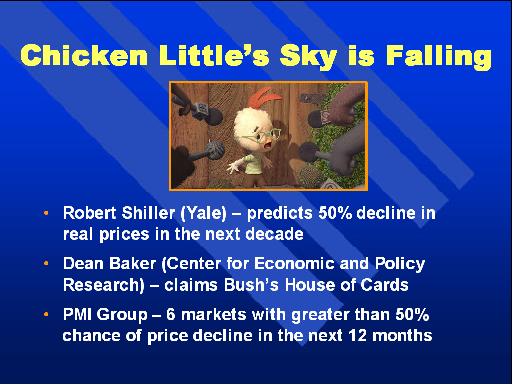
No one forced anyone to sign but only a few years ago, anyone calling a housing bubble was labeled as a Chicken Little. Take a look at this PowerPoint from a big housing presentation calling any bubble believers Chicken Little back in October 2005:

Chicken Little Slide from Presentation

Many other quotes, information, and articles can be found at the once great site, David Lereah Watch that is no longer positing since the NAR has replaced Lereah with a new housing bull, Lawrence Yun. These people are important because they are the Chief Economist to one of the, if not, most powerful housing associations in the nation. The NAR has membership of over 1.2 million folks and the majority believe the party line. They have large advertising and marketing campaigns that fund their industry. In addition, these industries are some of largest contributors to both political parties. Do you think they are looking out for you or Mr. John worrying about the risky new buyers coming into his neighborhood?


There is a great article in the Orange County Register that came out August 12 called One street’s subprime struggle. It talks about a block in Santa Ana that is the epitome of the subprime risky mortgage collapse. There is one fantastic quote from one of the older owners who is almost done paying off his mortgage:

“"I never sell. I never refinance," Zambrano said. "I don't take money out of my house to buy a car or take a vacation. I'm not stupid."

Don’t tell that to some folks in the housing syndicate. They may think you have bad money management skills and will try to get you to slap a virtual American Express to the side of your home. Maybe John has a point about being frugal and trying to manage his debt wisely. Should we try to convince Mr. Zambrano about his poor money management ability and tell him about a wonderful HELOC that’ll fund a nice trip to Europe?


Did You Enjoy The Post? Subscribe to Dr. Housing Bubble’s Blog to get updated housing commentary, analysis, and information.

August 04, 2007

Nostradamus in the House. Looking at 4 Potential Scenarios for Southern California Housing.


I couldn’t resist the “in the House” pun but it is becoming apparent that people are placing their bets on what is going to happen now that the housing bubble is bursting. It doesn’t seem like there is any debate regarding that we are in fact, living in a bubble. Subprime lenders are realizing once rates went up, people just said screw it and let the mortgage notes role on in without payments. No complicated economic theory behind it, just common sense which seems less common as each day progresses. With the foreclosure process taking anywhere from 3 to 6 months, folks don’t seem too concerned about getting their credit ravaged like Barry Bonds at a Dodger game. I mean why would someone fight vigorously to defend a home that in all likelihood, isn’t worth what they paid for it. For honor? The person that gave the mortgage is likely no longer employed and the note is chopped up like sushi in the mortgage backed securities markets. It isn’t like your local WaMu personal banker is going to give you a call and say, “Hey Mike, is everything okay? What is going on?” The personal touch is gone. The more likely scenario is your going to get a legal letter from the lender in your mailbox saying pay up or else. Most people in subprime loans feel screwed so they are simply returning the favor to lenders. I mean what are they losing? Their credit? They are freaking subprime to begin with! Its not like they are feeling an emotional ache in their heart that their 580 credit score will drop to 400. And you wonder why the market is tanking? With $1 trillion in loans resetting this year, 2008 and 2009 we can expect much of the same.

So it is established that the housing market is no longer a viable rock solid investment. So what can we expect to face here in Southern California or any other large overpriced metro area in the country? In this article, we will use the clairvoyant power of Excel and run four likely scenarios that will occur here in Southern California. We will use the current median price, current income, and try to predict future scenarios. Consider it a housing premonition.

These are the key reference points we will use:

  • Current Southern California Median Single Family Home Price: $502,000
  • Current Southern California Media Income: $60,000*
    • Los Angeles County Family Median Income: $43,518
    • Orange County Family Median Income: $58,605
    • San Diego County Median Family Income: $51,939
    • Ventura County Median Family Income: $59,379
    • San Bernardino Median Family Income: $43,179
    • Riverside County Median Family Income: $46,885

(Source: Census.gov)

  • Income growth of 5 percent annually.

*We’ll be generous and use an upper-limit since we are looking at the ENTIRE region.

Scenario #1 – Housing Goes up 10% Each Year for 5 Years

You may be thinking to yourself, there is no way this can ever happen. Well keep in mind that we did have 5 years and 2 months of 10+ percent year over year gains in Los Angeles County so not only can this happen, it did. In addition, before 2007 hit full stride, we had many housing pundits predicting double-digit growth! Each month after more and more negative housing news, they slowly scurried away and now they are silent in the dark green jungles of mortgage implosions. Irresponsible public policy and financial negligence led to this mess. But let us humor these heroes and take a look at how these scenarios would look if we let them run their course for another 5 years:

Median Home Price: 2012

year

income

2007

$60,000

2008

$63,000.00

2009

$66,150.00

2010

$69,457.50

2011

$72,930.38

2012

$76,576.89

While the current annual income to home price ratio is hovering around 8.3, by the time 2012 hits it will be approximately 10.6! Keep in mind we are also using a higher reported family income. If we were to use current Census data the housing to income ratio would be much higher. What will the mortgage cost look like?

10 percent down with 30 year fixed at 6.5 percent:

Budget 2012

Price

$808,476

Down Payment

$80,847

PITI:

$5,441

Net Income After Taxes:

$4,785

You think we have affordability issues now? Just wait if we hit this scenario. Let us take a look at a more conservative 5 percent annual increase.

Scenario #2 – Housing Goes up 5% Each Year for 5 Years

Now we are being more conservative. As a matter of fact, Southern California is currently up, 2.4 percent year over year. Housing bubble? Not here in the ever resilient SoCal market. Let us take a look at a 5 percent annual appreciation rate (which is more historically accurate):

Clearly this scenario seems more probable. Let us run the numbers once again with the 5 percent annual appreciation rate:

Budget 2012

Price

$640,693

Down Payment

$64,069

PITI:

$4,311

Net Income After Taxes:

$4,785

Okay, now at least we aren’t running into monthly household budget deficits. But the basic monthly nut will consume 90 percent of our net take home pay of the hypothetical median income family. Talk about taking it to the house. Let us now look at some more bearish predictions. First, let us examine a 5 percent annual decline.

Scenario #3 – Housing Goes down 5% Each Year for 5 Years

Even at a 5 percent decline annually over 5 years, we now see the median house price hit $388,438. Many in Southern California haven’t seen the fabled $300,000 mark in many years. Can it be possible that we have a blast from the past? Let us break down this scenario:

Budget 2012

Price

$388,438

Down Payment

$38,843

PITI:

$2,613

Net Income After Taxes:

$4,785

Now this is looking more reasonable. And all we saw was a 5 percent annual decline over 5 years. Not exactly a horrific crash or bubble bursting. In this scenario, the monthly housing nut will only take 54 percent of our net income. Seems like we are approaching a more realistic and reasonable environment. For the heck of it, let us do our maximum doom and gloom scenario of 10 percent annual declines for 5 years. After all, we did see 10+ percent increases for 5 years (sometimes even 20+ percent annual gains) so why not on the downside?

Scenario #4 – Housing Goes down 10% Each Year for 5 Years

Now most folks cannot imagine this scenario. Are you telling me we can actually be in the $200,000 range? If we follow the above scenario that is where we will eventually end up. $296,426 doesn’t even get you a studio apartment so how can it ever purchase a single family home? Let us see how the household budget works out:

Budget 2012

Price

$296,426

Down Payment

$29,642

PITI:

$1,994

Net Income After Taxes:

$4,785

We actually have a monthly payment of under $2,000. Now, the housing nut only takes up 41 percent of the median family’s net income. Keep in mind in more prudent times, most financial advisors recommend that housing not consume more than 1/3 of your household income (some go with net and some use gross). Either way, even with our massive decline of 10 percent year over year for 5 years, we are finally reaching parity with ancient financial standards.

I hope the above gives you an idea of how ludicrous it is to expect 10 or even 5 percent continued annual appreciation rates. Unless income starts going up by 10 or 15 percent a year, the positive scenarios will simply not happen. There are two questions that I’ll throw out:

1. Do you think housing will slowly decline or will it happen faster and more abrupt?

2. Do you think interest rates will go up? Because if rates do go up, the above scenarios will make it even more difficult for the average family to purchase a home and not stretch their budget like Gumby.

Related Articles:

The Housing Tipping Point

10 Real Homes of Genius in 5 Southern California Counties

The History of The Los Angeles Housing Bubble

The Foreclosure Story: $130,000 Income and Going Through Foreclosure

Did You Enjoy The Post? Subscribe to Dr. Housing Bubble’s Blog to get updated housing commentary, analysis, and information.

July 30, 2007

American Home Mortgage Halts Trading Pending News: Market Cap Down $221+ Million Over the Weekend. SoCal Still in Wonderland.


According to CNN, American Home Mortgage (AHM) is another company facing issues regarding the subprime fall out:

“NEW YORK (Reuters) -- American Home Mortgage Investment Corp. shares sank on Monday after the home loan provider announced "major" writedowns, delayed a dividend and said lenders were demanding it put up more cash.

Shares of American Home were down 39 percent, falling in pre-market trading to $6.39 from Friday's close of $10.47. On Friday the shares hit their lowest level since April 2003. Trading on Monday was halted for news pending.”

The beating AHM is taking is predominantly on their announcement to delay dividends on their stock. Guess when they announced this. Late Friday! Since AHM knew that if the announcement came any earlier, it would take a beat down like any of the housing related stocks last week. So they let it fester over the weekend and as of this posting, trading has halted on further “news.” But how much market cap was lost over the weekend? We always hear that massive corrections cannot occur over night but really in terms of money, how much was lost? Well let us take a look at some details regarding the company:

American Home Mortgage

Shares Outstanding: 54.28M

Price Per Share on Friday: $10.47

Current Pre-Market Share Price: $6.39

Friday Market Cap: $568,290,000

Pre-Market Cap: $346,849,000

Down in Two Days: $221,441,000

Here’s the thing. All things real estate can go down fast and dirty. Keep in mind this is only one example of many companies. The fact of the matter here is that this company has a market cap of half a billion dollars and is rather large. The disturbing part, as highlighted by the CNN article is you have a company as of the end of March, that had $4.01 billion in “warehouse” credit lines. It is becoming apparent that the subprime contagion is spreading all across the housing sectors.

In reality companies are valued on multiple fronts including their potential earnings or cash flow. For example, say you and I own a company with $40,000 in assets. We decide that we will only have two owners (shareholders) and have two shares outstanding. Therefore each of us would have a “stock” of $20,000 in the company assuming we have $0 in liabilities. Say we expect to earn $100,000 next year in revenue. Obviously the share price of $20,000 will jump up because of the projected earning potential. But what happens should we have negative cash flow? That is what is occurring with these companies but on a larger scale. Of course this is a rudimentary explanation but many of these companies are in similar situations like home owners facing massive resets yet have negative cash flow that they didn’t expect. In addition, your underlying asset gets impacted by negative growth potential. The market is calling it liquidity issues but ultimately it boils down to being unable to pay your bills.


Issues on the Home Front

And then we have stories like this one submitted by a reader of a Ventura Country couple trying to sell their home at bubblicious prices. From the Ventura County Star:

“The Conroys might have aimed high at a time when the market is soft. The most comparable home with similar square footage in the Golf Course Villas had an asking price of $759,000 and sold for $773,500 in October, said Joe Virnig, president of Ventura County Coastal Association of Realtors. He said he believes the same pricing strategy would have been successful for the Conroys.

Doughtery thinks the weekend's event will likely expedite the sale, but not without a cost.

"I think if you want to unload a property for less than the actual value, then this is the way to go," he said.

Still, Virnig warns there must be a catch to this type of marketing tactic, and calls it a "gimmick" to get people to see the house. It's the first time he's seen such a strategy in Ventura County.

"I have trouble believing they'd honor the $594,000 price if that's all they get," he said. "I see all kinds of problems with real estate agents adopting these tactics. I'm not about to adopt it — it's fraught with risk. Until the inspection period is up, it would be difficult to be sure that you didn't end up buying a problem."

You should really examine the entire article but the fact of the matter is we have people stuck on housing bubble yesteryear prices. They are asking $849,000 when a comparable home sold last October for $773,500. Even the fact that they are "entertaining" offers above $594,000, they are still in the belief that they can yield top prices from their rhetoric. In addition, I’m not sure if they are aware, we are in full out suprime and Alt-A meltdown mode therefore limiting access to whacky LaLa land credit. So the pool of buyers is limited in comparison to October of last year. In fact, standards didn’t get tighter until Q1 of this year. So they may look at the $773,500 price and laugh at it, but they’d be lucky to even get that. And the scary part of the article is that there are many folks still looking to jump into the game. Thankfully, I’m sure many of these would be buyers are having issues getting mortgages since they probably don’t have a sufficient down payment and Wall Street is done with the creative financing game. Even in today’s absurd market, all you need is 5 to 10 percent to get top notch mortgage products and rates. Yet with our negative savings rate, this is obviously too much to ask.


Subscribe to Dr. Housing Bubble’s Blog to get more housing content and your full dose of Real Homes of Genius.

July 19, 2007

Big Ben and the Ministry of the Fed: Housing Doublespeak. NovaStar Shining.

One important rule for investors is don’t chase bad money with good. NovaStar Financial is having a challenging time getting out of the doldrums even after a $150 million booster shot it received from private equity funds. Not only are analyst predicting a future price target of $4.50, much less than the current $5.96 price but the company is also planning on slashing the dividend for many investors. Keep in mind this is a company that once was trading as high as $64 a share. But home equity lines of credit and loans are much more expensive now that rates have shifted. 30 year fixed rates are still doing fine at historical lows, but financially, this was a small sliver of the pie for these subprime players. According to Reuters:

“NovaStar shares were down $1.15 to $5.96 in late-morning trade on the New York Stock Exchange after falling to as low as $5.91 earlier in the session.

As a result of the deal, FBR's Valentin said NovaStar common shareholders will see their dividend slashed to $2.67 a share from $4.21 a share. Valentin also said the $150 million injection is not enough to sustain NovaStar, a REIT, unless mortgage markets suddenly rebound."

Like other subprime lenders, which make home loans to people with weak credit, NovaStar has suffered rising defaults and has struggled to sell the loans it makes to investors. Quarterly results have suffered this year, while rivals were prompted to exit the business or forced into bankruptcy.”

This isn’t something new. I warned about the subprime implosion a few months ago including the challenges NovaStar would face. Although many pundits were echoing that $150 million dollars would keep the company solvent for a while longer, there is no way any amount of bad money would keep over inflated assets high forever. And the caveat in the above quote is “unless mortgage markets suddenly rebound.” Now do we really see that happening?

Big Ben Chimes in Again

Then we move on to Big Ben using his glorious Orwellian Doublespeak. First, Mr. Ben is frustrated that the Yuan is rising at a slow pace:

“"I share your frustration about the slow pace" of China's currency revaluation, Bernanke said in response to a question from the Senate Banking Committee following his twice-yearly Congressional testimony.”


Glad he shares the frustration of the American public. Well that can easily be remedied by raising the Fed interest rate. Of course this will pop the bubble. But why should housing pundits worry? They’ve mentioned that housing rose on its own merits without the crutch of easy credit. When asked if housing could face a hard fall, this is his response:

“"We think it remains a risk, we have an inventory problem,"


An inventory problem? Well isn’t that something! And here I was thinking that it was a pricing problem. The doublespeak gets better in this testimony. When asked about the overall state of the economy, Ben responded:

"The ongoing housing correction could prove larger than anticipated, and energy and commodity prices could continue to rise sharply" and that could "spread to other parts of the economy," said Bernanke. Therefore the "upside risks to inflation is [the Fed's] primary policy concern."


You’ll understand that political operatives love using the word “could.” Well I could make a million dollars tomorrow, or not. Well housing could correct, or not. And they keep calling it a “housing correction.” This is a bursting credit bubble! Call it what it is. All these convenient euphemisms make it seem like we are in a high school band class. So the primary concern is inflation. Excellent, at least we agree on one thing. Then what about the resounding housing inflation we have seen in the last few years? The Fed actually created this monster by lowering rates and creating excessive easy credit. This played perfectly into a society that has a very hard time saving for retirement or anything else. Not only that, it made everything you buy with credit cards easier. Even last year, it was incredibly easy to find 0 percent offers on credit card purchases. Try finding these deals now. Now they include a 3 percent transaction fee. Suddenly people can’t play the mortgage refinancing musical chairs game.

“"The most pressing issue facing the U.S. economy today is excessive and growing inequality,"
Bernanke responded by pointing to other studies that show middle class Americans are generally much better off now than they were two decades ago.

But he also said better education training programs, as well as cheaper access to health care, are some things that could be done to lessen the income gap.”


Basically you are doing better if you aren’t buying your first home, eating food, don’t get sick, and avoid going to college. Aside, from that you are doing fantastic! Amazing double speak in face of the largest housing inventory in multiple decades.


Subscribe to Dr. Housing Bubble’s Blog to get more housing content and your full dose of Real Homes of Genius.

July 17, 2007

Sales Drop Their Pants in Southern California. In More News, Median Prices Still Strong Like Arnold Schwarzenegger.


What a shock that housing median prices are still holding strong. In the land of Oz otherwise known as Southern California, June data released today shows housing prices resiliently strong with one caveat; sales are falling off a cliff! So even though Los Angeles County has a median home price of $545,000, a 4.8 percent yearly gain and Orange Country has a median home price of $645,000, a 0.4 percent yearly gain the devil is in the sales declines.


Los Angeles is down 32.5 percent in sales numbers. Orange County is down 31.6 percent. Riverside is down 47.2 percent. San Bernardino is down 50.1 percent. San Diego is down 22.6 percent. Ventura is down 27.8 percent. After each sentence I expect you to say Hoorah! Here is an excellent test of housing sentiment. In July of 2006, only one year ago we were having double digit sales drops but pundits kept hyping the yearly gains in the median income. “Sales drops mean nothing. Look at the tasty yearly median gains! Housing is hotter than a burnt tamale.”

Of course any person who studies housing markets realizes that drops in sales volume are indicators of where prices are heading. Housing is sticky on the way down. But the ironic thing is you don’t hear the housing syndicate jumping up and down for the positive median home prices just released. Why? Because business is horrible and the public is tired of being bamboozled. Just listen to the sentiment of the home builders. The summer bounce isn’t here and we are quickly approaching August. Suddenly visions of infinite double digit gains start to seem more distant. Summer 2007 is a vastly different housing market. For one, the subprime market is imploding. Imploding? Seems abstract to say it that way. How about “no more mortgages for LaLa land investments.” Aside from irresponsible lending and delusional sellers, housing is coming back to Earth from a long vacation to Uranus.

The housing syndicate wants to blame the Fed and anyone championing tighter credit. If it were up to them, we’d be purchasing $2 million dollar homes while inflation goes along at 25 percent and every new buyer ended up in a 70 year multi-generational loan. They wouldn’t care. Sustainability is a word outlawed in the subprime industry. These companies have such little reserves, that a simple credit tightening brought many companies to their knees in a few months. And this on the back of the largest housing bubble in history. They could have easily built up their cash account to weather a storm over the healthy years; but why save when you can make money hand over fist loaning out ridiculous suicide loans? Wall Street ate them up.

Well now, thanks to the transparency of information most people look at the median price and just laugh because they know it is simply absurd and a horrible indicator of the current market. Sellers are still doing baby steps trying to lower prices by $10,000 or $15,000 on a home overpriced by $200,000. So it is in today's market. The great summer standoff. I predicted this many months ago. Call it the summer housing Easter bunny and he ain’t hopping in Southern California and time is running out.


Subscribe to Dr. Housing Bubble’s Blog to get more housing content and your full dose of Real Homes of Genius.

April 30, 2007

Mission Accomplished: 3 Housing Issues: Multiple Bottoms, Declining Dollar, and More Sub-prime and Alt-A Defaults.


It is said that the definition of insanity is doing the same thing over and over and expecting a different result. If we adhere to this definition, housing pundits must be clinically insane because since the middle of 2006 we’ve been hearing rhetoric of “yes, today we’ve reached bottom.” Amazing how these folks live on one way streets. During the past seven years, each new record high was welcomed and when asked if this was a peak most would respond that the sky was the limit. No end in their immediate future. If up to them, housing would appreciate 20% each year until the end of time. Yet now that we’ve experienced only two moderately challenging quarters the housing complex is ready to throw in the towel and issue a Siren call that this is the absolute bottom, mission accomplished. They would like us to believe their rhetoric as gospel and ignore every fundamental economic indicator pointing to the contrary.

Multiple Bottoms

Let us take a look at a few bottom calls from David Lereah, the chief economist for the National Association of Realtors:

May 25, 06: "This may be the bottom. It appears May is a little better." (Real Estate Journal)

September 25, 06: "We've been anticipating a price correction and now it's here. The price drop has stopped the bleeding for housing sales. We think the housing market has now hit bottom." (Bloomberg)

Dec 29, 06: "It appears we've hit bottom, the price drops are necessary to stir sales. It is working." (Globe and Mail )

Mr. Lereah also issued a bottom call in March but at this point why keep track? We also have Leslie Appleton-Young from the California Association of Realtors saying "Our economy is growing. We're running about on par with what we see nationally.” Apparently she didn’t take a look at the massive hit in GDP during the first quarter that came out last week. And of course we have the talking heads over at the Fed saying that we’ve reached bottom in the housing market. Sometimes I feel like I’m taking crazy pills listening to these folks. How can we be at bottom if for the next two years we will be facing resets of approximately $100 billion per month according to the MBA. Take a look at this chart:

Those in the housing syndicate would like you to believe that we lived through this in 2006 and housing was still resilient. Well for one thing housing was still trading in Pollyanna and easy money was flowing on Main Street USA. That came to a screeching halt in late February and March of 2007 with the sub-prime spigot being turned off. In addition, many folks that found themselves in trouble in 2006 were able unload to a greater fool since appreciation was still present. Now that appreciation is MIA and the sub-prime market is gone we are seeing incredible drops such as the 800% increase in NODs in California.


Declining Dollar

As Wall Street is dancing with the stars on the boulevard with 13,000, the dollar is heading in the opposite direction. Last week the dollar reached a new low and the DOW hit a new high. What the public doesn’t seem to understand or even care about is that massive orgy credit hurts an economy's currency. Even though a gallon of milk will cost you $5.00, twice the price from only a few short years ago, they are happy they have a 10% increase in pay over five years. Inflation is a stupid tax and apparently this is fleecing many in the public. Instead of decrying the government step in and protect the currency folks are happy that their 401k is up 4% for the year. In addition, this is another reason that housing prices are in the stratosphere. A declining dollar crushes purchasing power. So even though you are making more nominally overall you aren’t keeping up with the true inflation in assets. The CPI is a joke and I’ve discussed this many times, I doubt anyone believes inflation is 3% a year. Is healthcare 3% higher? Is housing 3% higher? The bulk of where Americans spend their incomes is massively up. Not sure if many care or even understand the implications of a declining currency. Maybe American Idol should have a PSA with Seacrest saying, “today please call your local congressman and tell them that you will not stand for your dollar being fleeced; and now, here’s American Idol.”

Sub-prime and Alt-A Resets and Defaults

We’ve all heard about the debacle in sub-prime loans. The absolute debauchery going on in companies such as New Century Financial have made many people recoil. Or cases where a 102 year old man was able to obtain a 25 year mortgage loan, apparently with new modified underwriting standards. Or the immigrant worker with a $15,000 salary purchasing a $700,000 home. These stories are tips of the iceberg of what we will be expecting in the next few years. But again, the pundits in the real estate industry maintained that Alt-A loans, those given to prime borrowers but with lax underwriting standards, are now taking a hit. Apparently good credit can turn bad instantly if put in a precarious situation. We are starting to see cracks in this system as well. Maybe this could be part of the fact that 30% of all jobs contributed in the past 7 years have direct ties to real estate. So if real estate goes down, these folks lose their jobs, and no credit can stay good with unemployment.

But don’t listen to the facts. This mission is accomplished. Housing has hit bottom. Go out and buy a home, it is your patriotic duty.

April 06, 2007

Irrational Housing: Insiders out Early and The Duesenberry effect.


Markets operate under the assumption that key players act rationally in most circumstances. Their premise is such that market stability is based on people acting to a set of according rules. Much has been debated about this because economics as a science is cold and aloof; it is a matter of simply stating the facts. Yet we have learned in the recent housing mania that market psychology and behavioral economics play a large role in how people interpret risk and what constitutes an investment. As most bubbles in the past, such as John Law’s Banque Générale and the South Sea Bubble, many bubbles burst and leap into another bubble. Why is this? The argument goes that in a bubble profit is a major driving force distorting stable growth for radical cancerous increases that are only supportable for a short time. After the glut of speculation is complete, those with a profit that cashed out on time feel the hunger for continued gains. This desire precipitates another bubble in whatever form it may be; technology stocks, real estate, commodities, or foreign investment. Either way, the pattern is such were a few successful insiders gut the system, leave burns on the psyche of a general public only to save up long enough to let the emotional scars to heal. Then they jump into the fire again with their resources ready to be distributed to those at the top again.

It is a disturbing gamblers rush to the top because those that enter a Ponzi game late will have a fate that is predestined. Those that enter the game early will have great success at the expense of those that enter late; after all what you earn is predicated on an infinite number of entrants and as a society we have finite resources and participants. Once this is realized the game is over and those left with no chair realize the music has stopped playing. During the 1990s we had unprecedented growth in the stock market. Returns of 25% a year were more the rule than the exception. The economy was blistering red to the point that Alan Greenspan claimed that we were seeing “irrational exuberance.” For AG to say something along those lines is amazing given the fact how he championed adjustable rate mortgages and lowered the Fed rate to the point that money was practically free. During the early part of this decade, we saw an enormous growth in housing gains. Let us take a look at a few reference points:

California Median: 1999

California Median: 2005

Growth in Percent

$178,160

$548,400

207%


Nationally the picture isn’t so drastic but we do see tremendous growth as well:

US Median: 1999

US Median: 2005

Growth in Percent

$113,100

$215,000

90%

While this data may not come as a surprise, it is useful to use these measure as a guide to frame the mania we are currently in. Housing is consuming a large part of American’s discretionary income and has become a major source of financing spending on consumer goods. This relationship is important to note. Since income is not keeping up with housing costs and other expenses, the ability to withdraw home equity and create additional streams of credit has given consumers the ability to sustain this bubble for a longer period. In many high cost metropolitan areas housing is now consuming 40 to 50% of a family’s net income, a far cry from the conservative 28% which most financial experts suggest. As we are facing a housing led recession, will consumers adjust their spending habits in accordance with declines in home equity? I argue that they will not because of the Duesenberry Effect and the relationship is not a direct one.

Duesenberry Effect

Loss of productivity does not necessarily go hand in hand with a loss of appetite for high consumption. No one will doubt that as a society, we are the world’s large consumers. Our saving rate is negative. The average credit card debt an American carries is $9,200. The Duesenberry Effect argues that once folks get accustomed to a way of life, for example Plasmas and BMWs, a $1 decrease in productivity does not equate to $1 reservation from spending. If anything, on the way down things will accelerate because people will try to maintain their style of life regardless of the loss of income or equity in their home. It is a fall from grace. Financial prudence isn’t the forte of the American public and this massive readjustment and recession will cause a lot more pain than many are envisioning.

No rational argument can demonstrate that a stagnating home market and wages will force individuals to readjust their spending habit. If our national trade deficit is any indicator, we are only becoming more hungry on ways to finance our appetite via credit. The reason the subprime implosion is so crucial and important is because this funding source is now evaporating. Wall Street is not happy with Collateralizing any more funny money debt; the idea of mixing feces in a large sea of good money. Investors gathered that if the pool of funds was large enough, bad and risky debt would be hedged into the matter and mixed in to the point that any drop would be supported and not noticed. This was all in good when the subprime market was tiny. But given that we have over $1.2 trillion in subprime debt originated in the past two years, we are now swimming in a black pool of our own consumption.

Insiders Out. Public In.

In each bubble, there is a privilege being in the know. Those that have insight and the fortitude to jump out early make out like bandits. Examining insiders selling of companies like Toll and New Century Financial, we see that large percentages of top officers sold at peak prices in 2005 and 2006. In addition, selling out of these positions is easier than liquidating a piece of real estate which all subsequent monetary value is derived from; there is no NEW without housing and there is no Toll without people purchasing homes. Many wonder why bubbles go on longer than they should. Again this assumption relies on the fact that markets always act rationally. But in a mania, the market is anything but sane. Mania, as in acting without direction, highlights an amazing ability for stupid money to chase to stupid products by stupid people. It is inevitable that people will and are getting burned for their financial indiscretions. The media will portray these poor individuals as being burned by big bad corporations hungry for a profit. They came too late to the party and unfortunately they were not able to flip a 800 square foot home for $50,000 in 6 months. As we know from studying mob psychology if everyone around us is going crazy and we remain stable, we will start sensing that we are out of our mind. At some point we decide to join the mob and follow the herd. That is why after a bubble has burst, many ordinary people realize that the game could not go on forever. Bubbles are also fueled by credit expansion and perception of quick wealth. Monetarist would have you believe that controlling the flow of money is key to sustainability. Well as you can see, now that the Fed has raised rates back up people are still hungry for housing; even if it means getting negative-amortization-no-doc-1-percent-teaser suicide loans. Essentially this act of financial irresponsibility is the “I’ll double down on 16 with a casino margin because I know a 5 will come out.” And why not? For the past 7 years we have been in a historical global credit expansion fueled by housing. When your home is your Joe or Susie Bank, why worry about money when you can look in your basement and find $50,000 nestled next to your family heirlooms.

At this point there is no silver bullet. Rampant excess in the forms of the previous stock bubble and the current housing bubble will need to be purged. Simply put, the recession we intervened on in 2001 with easy money will come back with a vengeance either in 2008 or 2009. The course of action is already set and financial institutions have made their mint only to loot the market when it crashes. They are out and the public is in. Will enough people have the ability to get out on time? Probably not. We have an unsupportable Social Security system, a costly war, and inflation. Inflation? If you still believe the CPI is an accurate indicator of inflation than you probably believe war is peace and hate is love. The main items that consume your income are housing, healthcare, education, food, and energy. Do you think there is no inflation? Once this permeates into the markets and if there is a global fear, the Fed will be forced to raise rates or face a crashing dollar. They have come out publicly many times that their goal is to have a stable dollar. Trying not to sound like the "Architect" in the Matrix, Ergo the housing market is done.


Insiders have cashed their chips. Many in the public are looking at yesterday trying to predict tomorrow. This upcoming recession will undress the ability of Americans to cut back in the face of a contracting economy. Do you think this is going to happen?


April 03, 2007

Manias, Panics, and Crashes: 2007 First Quarter All-Stars – Foreclosures, Subprime, and Politics. Five Characteristics of a Housing Bubble.


“Much has been written about panics and manias, much more than with the most outstretched, intellect we are able to follow or conceive; but one thing is certain, that at particular times a great deal of stupid people have a great deal of stupid money”
–Walter Bagehot

As we look back at the first quarter, we realize that 2007 will be historical in terms of the housing bubble bursting. It is well documented throughout history that ordinary folks are capable of unbelievable spending and gambling. Examples include the South Sea bubble in London, the Mississippi bubble in Paris, The Great Depression, and more recently the dotcom bust. It would seem that financial speculation transcends a fixed point in time. Each bubble that forms follows a set pattern that we have witnessed in the 21st century with global real estate and the massive credit that floods the world’s marketplace like Scotch at an upscale bar. Just open your Sunday paper and look at current housing prices if your stomach has the fortitude of a tiger; if you are in one of the many overpriced metropolitan areas welcome to a firsthand account of an asset and credit bubble.

We are starting to hear massive jawboning about what is the correct path to address this financial mess and the word bailout is threaded in many a conversation. It would seem that the political de jour of the day is the subprime fallout. Well this would make sense since foreclosure are up a mouth dropping 145% in California. That is stage one followed by the fact that the subprime business market is being gutted one by one as if a mechanic is taking out an engine to rebuild it. I have addressed the subprime blow out many times and have an inkling that the mainstream media will start to run with it. As the first quarter ends, we see that foreclosures are through the roof, the subprime market is imploding, and political jockeying is starting. Historically, these are symptoms of a mania but pundits would like you to believe otherwise claiming that we are facing a new paradigm or some sort of abracadabra black magic. I have listed 5 key points that are addressed in an old great book called Manias, Panics, and Crashes by Kindleberger and relate them directly to the current state of the housing market we are living in. If you look at the below stages we are in step 3 of the 5 stage process.

#1 – Speculation

No fire can expand without fuel. This is a law of nature. And no bubble can grow without and audience to inflate it. In the first stage of the housing bubble, we see a flight out of the stock market into safer illiquid assets. This was spurned in large part by the events of 9/11 and the absolute pants dropping of the Fed interest rate. Most people in the public have very little understanding of fractional banking or how the Federal Reserve controls the flow of credit to commercial banks. After 9/11 and the short recession that was felt, money flowed into hard assets and people started spending. If you recall Bush addressing the American public that spending was a patriotic duty and instead of pulling out Desert Eagles we should pull out our Visa and Discover Cards. If spending is patriotic we must be peeing red, white, and blue after these last few years. What better way to blow your cash than to slap on a virtual ATM to the side of your house and loot all your equity. This leads into the credit expansion.

#2 - Credit Expansion

How can you spend money that you don’t have? You create it out of thin air. This isn’t some David Copperfield routine in Las Vegas but the ammunition that fed the housing bubble. The average American family carries $9,200 in credit card debt. In addition, we have a negative savings rate that is similar to the Great Depression. Home equity loans and lines of credit are the fastest growing debt areas:

Volume of Home Equity Lending by Type of Financial Institution (billions of dollars)

Year

Home Equity Loans

Home Equity Lines of Credit


Banks

Thrifts

Banks

Thrifts

1990

NA

NA

$69,441,439

$16,380,648

1995

$66,116,479

NA

85,027,381

12,889,414

2000

163,677,595

NA

133,271,483

17,484,625

2004 (first half)

88,428,888

$19,292,495

356,811,082

58,994,633

*source FDIC

Not only that, but the mortgage market is a behemoth at $6.5 trillion outstanding; with that we are expected to see $1 trillion of that reset in 2007. With all this free money floating around is it any wonder why we have seen massive asset inflation and a declining dollar in the past seven years? There is more green than the Amazon forest but this is why we don’t feel richer as a society. The problem of course is, if you use your credit card or HELOC you are essentially creating money out of thin air. How? Well if I go and buy a $3,000 Plasma with money that I don’t physically possess, how is this not tantamount to me being my own bank, underwriter, and ATM? At a certain point, interest and prices become so disconnected with actual values that we start seeing cracks in the foundation. The next step is where we currently sleep, the financial distress state.

#3 - Financial Distress at Peak

As I mentioned foreclosures are up in the triple digits here in California. Phoenix is seeing the largest inventory on its books. Detroit is selling homes for cheaper than cars. Florida isn’t facing a soft landing but a rather hard one. Does this sound like a healthy housing market? By any measure, this housing mania is rampant throughout the United States.

Early in March, we saw the light that ignited the housing bust. The subprime mortgage implosion has brought into question the resiliency of the US economy in the face of a declining housing market. With the data presented above it would appear we are very dependent on the housing market. Now what is typical at the peak of any bubble is the emergence of absolute malfeasance in financial prudence. Welcome court jester New Century Financial, once the third largest subprime lender in the US is now belly up and trading on the OTC. A company now worth approximately $80 million in market cap owes $8.4 billion; now that kind of leverage you will never see in a late night infomercial. Other subprimers such as NovaStar and Fremont face the same fate as New Century. Now we are seeing this virus spread into builders such as the recent announcement that Beazer homes will be investigated.

The public is catching wind of this storm and is hungry for blood. Why wouldn’t they be? They are starting to suffocate on interest payments and the only beacon of hope was a rising housing market. Now that appreciation is reverting and many homes are now underwater, folks are angry. The ATM is now blinking in big red letters “out of money, will refill TBD.” Which leads us into the next stage.


#4 – Crisis


How the crisis will unfold is anyone’s guess but it will unfold in some familiar manner if history is our guide. Now that the discussion of a housing bubble is rather mute because most sane folks acknowledge that we are in a housing bubble, we are starting to understand the intricacies of corruption and greed that are prevalent at the peak of a bubble. With this crisis mode in full swing, we are hearing both Senator Dodd and Hillary Clinton utter the words bailout. Amazing how all these free market capitalist and laissez faire theorist argue that the government needs to stay out of the market completely and all of a sudden many are asking for government assistance. They were utterly happy to flood the market with funny money but now that the market is turning off the spigots, they want to go on life support with Uncle Sam. The irony is so thick we need a chainsaw to cut it. This moral posturing is unbecoming and companies such as New Century will prove to be the future Enron’s once we enter crisis mode in the near future. To paraphrase Buffet, we’ll see who is swimming naked once the tide is out.

#5 – Crash and Panic

Most bubbles pop quick and utterly fast. The unwinding of a bubble is likened to a cat grabbing the end string of your favorite grandma’s knitted sweater and darting off. Nothing can prevent the collapse because it is literally built on a house of cards. If an economy is build on the belief that housing will always go up and credit will always be freely accessible then it will fall. Whether this was explicitly stated does not matter because the large part of the American public voted with their wallets. This is obvious; as much as we would like to believe that redwood trees could grow to the heavens they do not. This housing bubble will go down in the history books with all the other manias. We are not special in the eyes of economic fundamentals and basic human nature. Why would someone pay $500,000 for an 800 square foot home? Why would someone pay $200 for a share of stock in a company with no earnings and no prospect for growth? Why would someone sell off all their livestock for a tulip bulb? I guess hindsight is always 20/20 and making an easy buck will eternally live in the human psyche.