August 16, 2007

Lessons From the Great Depression: A Letter from a former Banking President Discussing the Bubble.


As we hit record lows with the markets, it is clear that we are entering a correction phase. With the incredible response we had to a personal letter from a lawyer discussing in great deal, the failures of the previous Great Depression bubble we can see many parallels emerge to our current potential future. For one, the wanton greed and disregard of financial prudence. The inability to see beyond the current market and realize that history has a mischievous way of sneaking up on those who forget her. There is no longer a debate regarding the once fabled housing bubble. We can all take off our tinfoil hats off and begin to construct a vision of the future in the midst of a collapsing housing market. Today I’ll be posting an article that came out in the Saturday Evening Post in November of 1932 from a former bank president in New York, three years after the crash, highlighting the economic situation of a post bubble world. This is an old article so I retyped the important paragraphs:

“If I draw illustrations from the banking field to indicate the limits to which the depression reached, it is only because I am writing about banks and not because the banks are the one glaring example marking the extent of the financial cataclysm. The railroads, the insurance companies, the building-and-loan societies and mortgage companies would quite as well depict the situation.”

The collective memories of many Americans believe and associate the Great Depression igniting from the heart of Wall Street. However, it is clear that many industries built around financial imprudence also failed during the Great Depression. Think of the many industries currently facing hard times with the housing decline: insurance companies, mortgage lenders, hedge funds, the auto industry, home remodeling centers, and many other housing associated industries. Can it be that for the past decade, we have been using the home as a center of economic prosperity? Clearly it has helped to a certain extent with unparalleled amounts of mortgage equity withdrawals. There are estimates from the FDIC that $5 trillion in wealth has been directly linked to this housing boom. How much was really lost during the three years following the Crash?:

“The decline in the price of bank stocks was only a minor phase of our debacle. The quoted value of all stocks listed on the New York Stock Exchange was, on September 1, 1929, $89,668,276,854. By July 1, 1932, the quoted value of all stocks had fallen to $15,633,479,577.”

“Stockholders had lost $74,000,000,000. This figure is so large that not many minds can grasp it. It is $616 for every one of us in America. It is, roughly, three times what we spent in fighting the World War. The bursting of the South Sea Bubble concerned a single company. In the bursting of the New York Stock Exchange bubble, the value of all stocks fell to 17 per cent of their September 1, 1929, price – almost as great a drop as the South Sea Company stock, with its fall to 13 per cent of its top price. Remember that this calculation is not a selected example. It is made from the average of all stocks listed on the Exchange.”

So $74 billion was lost. A massive amount. What would happen if say the $5 trillion in housing wealth would suddenly disappear? Instead of bank failures we are now facing hedge fund debacles and everyday it appears that another mortgage outfit is closing shop. Mortgage resets are hitting the market to the tune of $30 billion a month with our peak month hitting in October with $50 billion resetting. We will not fall below the $30 billion monthly mark until September of 2008. Most experts are now predicting a declining market until 2009 and these are optimistic projections.

“The South Sea Bubble wasn’t so much! We have done pretty well in the way of bubbles in our own time. All financial history shows no parallel to what we have been going through. Never before, in this country or anywhere else, has there been such a general loss in “security” values.”

Bubbles will always occur in profit driven systems because of human nature and bubbles will bust when they reach a Minsky Moment. In addition, the psychology at a certain point tips and the market no longer follows previous rules. The system was built on consistently appreciating real estate and when this ended, it turns out that millions of people were swimming naked. The only question now is how long will the market retrench. Unbelievably, those that pumped up the bubble are crying for compassion for the desolate homeowner now losing his home even though he is laughing all the way to the bank. Since he is partly responsible for the massive speculation, why doesn't he cut a check from his decade long bubble profits if he feels so bad? Instead, they want the entire nation to carry the burden of this massive credit orgy. If they truly believe in free market capitalism, then what is currently happening is the end result; the market is washing out all the excess from the system. Yet the Fed injecting liquidity amounts to corporate welfare and is only prolonging the inevitable decline.

“The decline in the quoted value of New York listed stocks is only part of the story. The total of real-estate mortgages in default, particularly mortgages on city property, is unexampled. The value of real estate can no longer be accurately appraised, because the market for real estate has been practically paralyzed.”


We are already seeing this. Many REO properties are simply sitting on the market and stubborn lenders and sellers are refusing to lower prices. Buyers are refusing to buy or are unable to get loans. It is a Catch-22 that is accelerating the market on a downward spiral. People realize that housing is going down and are suddenly reluctant to buy. The MBS market now seeing the intestines of their portfolios is realizing that some overpricing may have occurred. I’m not sure if any of you have seen the new housing syndicate marketing angle (I caught a glimpse of this on late night infomercial happy television). They are now pushing, get this, FHA loans! Suddenly, the industry that pumped interest only, hybrid, reverse mortgage, 2/28 loans, stated income, and every other weird concoction of loans is coming home to the safest of the safe. But the scary implication here is they are touting, “no need to worry here, these are government insured.” Guess that means the American tax payer is going to bail out the housing industry. At least this is what the housing industry expects.

“The loss of $74,000,000,000 in the value of New York listed stocks is something more than a mere item of financial data. Implicated in it are ten million cruel heartaches. I am using “million” as an adjective, and making an understatement. The laborious savings of an uncounted number of lifetimes have been swept away. Prudent provisions for the future has been made to contrast unfavorably with the pleasures of spendthrift waste…”

The real pain is in what happens on a micro level. Like the couple earning $130,000 a year that lost their home to foreclosure and is now facing hard times; these are the real stories behind the bursting bubble. What is the psychological and financial impact of those put into 2/28 homes and are now facing foreclosure? There is no financial benefit to the buyer for jumping into a 2/28 loan aside from squeezing into a home they cannot afford over the long run. The only one benefiting from this is the mortgage broker who gets a stronger kick back for putting you into a risky loan and the agent from getting a commission check after escrow closes. What do they care? The loan is getting an extreme makeover on Wall Street and they'll never see it again. The transparency legislation now being pushed is 7 years too late. Wall Street has turned off the spigots earlier in the year. Don’t worry about the large mortgage outfits, many top CEOs and executives actually sold out [are in the process of selling out] near the peak.

“Not only did our investments shrivel in the last three years but we even frequently lost our pocketbooks. Cash in hand, left for safekeeping in a bank, often went the way of our investments, and worse. Almost $3,000,000,000 of our daily-used cash funds were sequestered in the doubtful assets of the 4835 insolvent banks. Widespread communities were left with only the mattress as a safe depository, and with little to put into it. People became so frightened in regard to the safety of the banks that they locked up in safe-deposit vaults, or selected elsewhere, more than $1,500,000,000.”

We don't have to worry much about losing savings accounts considering Americans now have a negative savings rate. Try imagining you are now in 2009. What do you think the sentiment of the American public will be when trials are going on regarding shady lending practices? Many defunct companies are now getting their legal houses in order preparing for this. Even with the previous scandals such as Enron, many folks saw this as something far and away since few even understood what Enron did or what laws they broke. But everyone will understand the debacle of the housing industry because it hits every American. It is a simple story of greed and financial negligence. And one thing is certain, Americans do not like gambling with their homes unless they are winning. Now that many are losing, they’ll be out for blood. The Democrats are already taking aim and claiming it is the mortgage brokers fault for putting us in this mess. Of course there are other major players including the Fed, hedge funds, buyers/sellers, agents, appraisers, and flat out greed.

“This is a shameful and humiliating exhibition. It is uniquely bad. Across the border in Canada, there was not a single bank failure during our period of depression, and one must go back to 1923 to find even a small one. Nowhere else in the world at any time, were it a time of war, or of famine, or of disaster, has any other people recorded so many bank failures in a similar period as did we. We were not experiencing a war, a famine or any other natural disaster. All the economic tribulations we have undergone in the past three years have been man-made troubles, and Nature has continued to shower us with an easy abundance – more, indeed, than we have known how to distribute with economic wisdom.”

We are facing a healthy economy as well. Unemployment is low. Wages are holding steady. GDP is still growing. Too bad most of this growth is heavily influenced by the credit bubble. Like the former banking president states, this credit bubble mess is another "man made problem" as well. Where this market will take us is anyone’s guess but I’ll leave you with the final paragraph of the article:

“Human stupidity and cupidity were the taproots of this great financial disaster. Those are evils which will always best us. There have, however, been revealed faults and weaknesses in our banking and investment practices that account in part for the extreme nature of this experience. Isn’t it about time that we began thoughtfully to examine some of the fundamentals of our banking and investment theories and methods?”


Did You Enjoy The Post? Subscribe to Dr. Housing Bubble’s Blog to get updated housing commentary, analysis, and information.

August 14, 2007

Greater Expectations: Quotes and Psychology of a Modern Day Housing Bull.


John is a hard working middle-class man in a mixed blue collar and upcoming white collar neighborhood. A vestige of old times when working class groups of families purchased homes before the mention of any housing bubble or subprime mortgage ever hit the CNBC newswires. Now this neighborhood is experiencing a Renaissance that doesn’t include blue collar working class families. “I wouldn’t be able to purchase my own home if I were to buy it right now,” echoes John as many families in this neighborhood feel the same sentiment. The idea of using interest only mortgages or refinancing to tap into mortgage equity seem like a foreign language to his frugal and debt free way of life. The only debt that he has, he proudly tells me, is the mortgage debt which he only has a few years left to pay off. Welcome to a bygone era and the rhetoric of a past decade. We are living in a time where the definition of “home” is radically shifting. Take a look at some quotes from the ex-head honcho of the National Association of Realtors had to say over the past few years:

March 2005: " I believe that in years to come historians will see the beginning of the twenty-first century as the "golden age" of real estate. And I want to persuade you to take advantage of this historic opportunity. "

Source: Are You Missing the Real Estate Boom? Why Home Values and Other Real Estate Investments will Climb Through the End of the Decade-And How To Profit From Them" March 2005, p4. Author David Lereah

What made real estate so special in March of 2005? Did it all of sudden become supernatural and have uncanny healing powers? Nothing really changed except the fuel of a massive credit bubble and rhetoric like this was swallowed by buyers and sellers believing that they somehow found El Dorado and an endless money pit in their home. This language started many years ago but you can see even as of March of 2005, the psychology of many in the housing syndicate was such that housing was entering some kind of new era. Remember the book DOW 30,000? Maybe someone should write 500 Square Foot Box, $500,000. Even the last sentence about “I want to persuade you…” echoes of a sales pitch for a speculative product. There was no frame of economic reference aside from a tiny window of 2001 to 2005 that of course, made it seem that real estate was the hottest investment on the planet. And it was. But not anymore. Like any speculative bubble, those that get in early and are able to time the peak make out like bandits. Yet those that come late to the party have a hard time figuring out what happened. Even as the market was clearly showing signs of bubblicious behavior, we get more absurd housing teeth gnashing.

August 2005: "If you paid your mortgage off, it means you probably did not manage your funds efficiently over the years. It's as if you had 500,000 dollar bills stuffed in your mattress."

Source: David Lereah quote, August 2005 LA Times quote

Say what? So let me get this straight, if you paid off your mortgage you somehow have a problem managing your funds? Of course, the assumption here is that you should use the money to buy more homes and flip them like the Ukrainian gymnastic team. Maybe you should slap the virtual ATM of home equity lines and loans to the side of your house and turn on the shiny chrome spigot and let the equity ooze out. And guess what? People believed this and actually followed the lead of the housing syndicate. Mortgage equity withdrawals became a new industry unto itself. The problem with the statement above is that it isn’t completely financially prudent. In fact, the better advice would be to sell a home in an overpriced area, rent, and ride the bubble down. But no one in the housing industry would say this because if you would sell and wait for a few years that would mean that the following isn’t going on during your sabbatical from housing: Sales go down, refinances drop, construction falls, home upgrades no longer happen, and anything else that lives on the butter churning housing industry. Sell, upgrade, refinance, rinse and repeat seems to have stopped and as you may have currently noticed, the way housing goes so goes the world economy.

April 2006: David Lereah, the Realtors' chief economist, said he was still looking for a gradual slowdown in housing that would result in a drop of around 6 percent in home sales this year and a slowing in price gains to around 6 percent, compared with the double-digit gains in prices in recent years.

Source: St. Petersburg Times, April 26, 2006

This statement above highlights another fallacy in the housing syndicate logic. Yes, real estate can appreciate by double-digit returns with no economic fundamentally sound reason however, the downside has a safety net of only single digit drops. Think about the implication here for the consumer. “Well, if I buy I have the potential of 20 percent returns but if the market goes down, I will only lose 5 percent for one year and then we’ll be back at double-digit returns.” Hedge funds live off these analysis. Risk assessment and running market assumptions on potential future scenarios. Most consumers didn’t do either but bought with the unconscious belief that housing will go up drastically but the downside was very minimal. Clearly, we are now seeing with some Real Homes of Genius that homes can drop $100,000 in one year. So if they are wrong about the downside what else were they wrong about?

September 2006: "With a general background of growing population and favorable affordability conditions, home sales are staying at very healthy levels," said Lereah. "As a result, we'll continue to see above-normal home price appreciation for the foreseeable future."

Source: Chicken Little's revenge, Salon

Strike three amigo. We are now facing housing depreciation on a national level, the first time since the Great Depression. He gave this opinion in the same month that Bloomberg mentioned this fact! And it doesn’t seem like we are on track for a bounce back this summer with the mortgage market debacle. So we’ve given them long enough with one year. Clearly the Chief Economist is the figurehead for his industry, and as such he speaks for many in the industry. I was listening to a local housing show on the weekends that discusses the real estate market and the host did an absolute 180. All of sudden, he turned into a Democrat and started blaming mortgage brokers directly for the housing debacle. “I can’t believe these brokers with subprime lending…” as he went off on his opportunistic CYA moment. Keep in mind, a year ago this same person was echoing the benefits of adjustable rate mortgages and pumping housing like the next great invention. Unbelievable. But that is the psychology of a good sales person; once one market is dry make sure you are prepared to jump into the next market. And this host was since he touted his incredible ability of refinancing and saving folks from foreclosure. Still trying to churn the butter. And he had a broker call in and gave him a piece of his leveraged mind, "what you are doing is wrong. What we need is the Fed to drop rates. We didn't force people to sign."


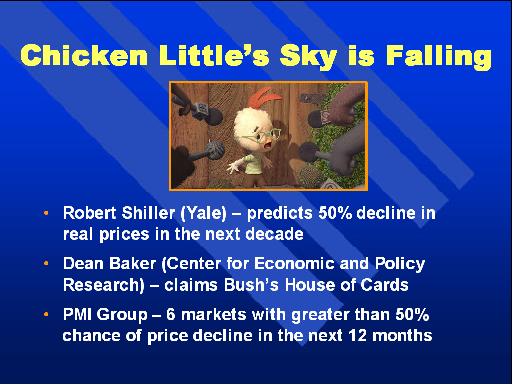
No one forced anyone to sign but only a few years ago, anyone calling a housing bubble was labeled as a Chicken Little. Take a look at this PowerPoint from a big housing presentation calling any bubble believers Chicken Little back in October 2005:

Chicken Little Slide from Presentation

Many other quotes, information, and articles can be found at the once great site, David Lereah Watch that is no longer positing since the NAR has replaced Lereah with a new housing bull, Lawrence Yun. These people are important because they are the Chief Economist to one of the, if not, most powerful housing associations in the nation. The NAR has membership of over 1.2 million folks and the majority believe the party line. They have large advertising and marketing campaigns that fund their industry. In addition, these industries are some of largest contributors to both political parties. Do you think they are looking out for you or Mr. John worrying about the risky new buyers coming into his neighborhood?


There is a great article in the Orange County Register that came out August 12 called One street’s subprime struggle. It talks about a block in Santa Ana that is the epitome of the subprime risky mortgage collapse. There is one fantastic quote from one of the older owners who is almost done paying off his mortgage:

“"I never sell. I never refinance," Zambrano said. "I don't take money out of my house to buy a car or take a vacation. I'm not stupid."

Don’t tell that to some folks in the housing syndicate. They may think you have bad money management skills and will try to get you to slap a virtual American Express to the side of your home. Maybe John has a point about being frugal and trying to manage his debt wisely. Should we try to convince Mr. Zambrano about his poor money management ability and tell him about a wonderful HELOC that’ll fund a nice trip to Europe?


Did You Enjoy The Post? Subscribe to Dr. Housing Bubble’s Blog to get updated housing commentary, analysis, and information.

August 12, 2007

Real Homes of Genius: Today we Salute you Arleta and Compton. Two Short-Sales for the Price of One.


I haven’t posted a Real Homes of Genius for sometime because the credit markets were busy being hit with the reality stick and exploding like a birthday piñata. Apparently, Wall Street got a few pictures of what was really stewing in their mortgaged backed portfolios and had a hard time justifying that a 600 square foot home was really worth $500,000 in the murder capital of the United States. Multiply this scenario thousands of times over in multiple metro areas and you have the current bubble bursting housing market. They say a picture is worth a thousand words. If that is the case, today’s article is worth $1 million plus a dictionary. So today, we will look at two homes that garner the award-winning label of Real Homes of Genius.


The first home is a spacious 1,045 square foot home in Arleta. With 3 bedrooms and 2 baths, you’ll be wondering what to do with all the extra space. Maybe you’ll rent out the extra room to cover the mortgage. As you can see from the above picture, the gates are slightly ajar welcoming you into your future Taj Mahal. This home is an architectural work of art because the garage is actually three-dimensional like a Rubik's Cube. The assessor has this place listed as 2 bedrooms but what the hell, the garage is converted therefore it is 3 bedrooms. It is a fixer upper according to the ad. So how much is this home listed for? A bargain at $449,000. Even with all the fantastic housing news hitting the media, we still believe that Southern California is immune to housing Armageddon. This Arleta home is priced to sell because the bank is fair and wants to help you own a piece of the American Dream. How many other folks realized the American Dream in this home? How about 3 families in the last 3 years. I guess the housing dream happens during the rapid eye movement segment of sleep in 2007. Let us look at the sales history before the bank decided to be the 4th owner:

Sale History

12/18/2006: $400,112

02/07/2006: $470,000

10/19/2004: $340,000

Didn’t you hear the news? Reinforced steel gates are replacing the mental image of the wooden white picket fences as the ideal for a suburban home. The bank, for some reason feels that this home is still worth a peak price. What is the median income of a family in this area? How about $52,673. And you wonder why so many mortgages are going bad? Unlike Milli Vanilli, this housing decline is real. Even families making $130,000 are having a hard time staying out of foreclosure so you can imagine how this one became another unfortunate statistic. These families are heading straight into bankruptcy court. How any lender got this past underwriting will be a question we will be hearing about many times over for the next few years.

The next home is a pink beauty in Compton. This 1,121 square foot home has 3 bedrooms and 1 bath. According to the ad, this home needs some cosmetic work. All you need is granite countertops and injections of Botox and you won’t be able to tell the difference between the Hamptons and this place once you’re done hauling your orange Home Depot cart back to your palace. How much for this piece of the American Dream? How about $294,400! This Real Homes of Genius is different from the home in Arleta because this bank has been following the credit mayhem hitting the global markets. How can you tell? This place is priced to sell and sell fast. With only 22 days on the market, the bank is not trying to put an absurd Wonderland price only to begin the weekly two-step of knocking prices down until some agent snatches up the MLS action. Let us take a look at previous sales history:

Sale History

05/23/2007: $342,493

05/01/1990: $103,000

So already, the home is $48,093 under the previous sale price in May. You’ve saved $24,000 each month simply because you are patient and a smart buyer. To put it in a different perspective, any buyer waiting two additional months has saved the median annual income of families in this area.

Do we really need hardcore derivate and credit analysis to give you a visual as to why the mortgage markets are imploding? Do you need a picture of what subprime looks like? This isn’t over pricing a home by 10 or even 20 percent. We are talking about homes that are overpriced by 50 percent. I can understand the difficulty for folks in the housing syndicate to come to terms with what is going on. But this is the reality of the current situation. Wall Street is now forced to go into the trenches of their toxic portfolios and unless they want to become property managers, they’ll need to unload these homes at whatever the market will bear. Moreover, lenders from what I’ve heard are so stringent and playing hard ball these days, that they are actually looking at income statements and asking for 5 to even 10 percent down. The humanity.

Today we salute you Arleta and Compton with our Real Homes of Genius Award.


Did You Enjoy The Post? Subscribe to Dr. Housing Bubble’s Blog to get updated housing commentary, analysis, and information.

August 09, 2007

Global Housing Bubble: International House of Subprime Lending.


It is becoming apparent that the subprime contagion is spreading into all areas of credit. And not only is it spreading, it is hitting the entire planet. This may sound like hyperbole, but news coming out regarding France’s biggest bank, BNP Paribas freezing $2.2 billion in funding and the European Central Bank injecting $130.5 billion into the money markets may demonstrate that this bubble has no respect for borders. The initial fear was rooted in the singular idea that the subprime mortgage collapse was contained in a nice and sanitary silo. Credit will still be gushing down the road like a summer thunderstorm and housing prices grew into the stratosphere. Now we are witnessing that this housing mayhem is no Rock of Gibraltar and is suddenly showing cracks. After all, even AIG is setting aside money for higher subprime defaults. So why is the process so slow and median prices remain stubbornly high? There are many reasons for the slow decline but three that we will discuss in this article are scheduled mortgage resets, overly optimistic scenarios, and market psychology.


The Revolving Reset Door

For the last decade we’ve been obsessed with the housing market. With new underwriting software, mainstream media shows, and the ability to tap home equity we became a nation fueled by housing appreciation. Never have we had so much refinancing activity and mortgage equity withdrawals hitting the economy. The perception that your home is an ATM and a virtual American Express card is something new. Even in past housing bubbles, the money was made by flipping or assigning rights of the property to another person. This bubble is in another dimension because with cash-out refinances and buying 2nd homes, home owners became on a microcosmic level mini banks. They had the potential to lend money to themselves. They assigned the ability to purchase 2nd homes via the leverage of their first home and the perceived equity. Many folks are learning a hard lesson that the equity in your home isn’t yours until you sell and have the cashier check in your hand.

The slow decline is happening because there is a systematic time bomb of mortgage resets waiting in the wing. Like a jaguar stalking its prey, it is lingering in the corner ready to pounce. How much is really resetting? According to Credit Suisse, the biggest month of mortgage resets will be October 2007 where $50 billion loans will reset for the first time. In addition, we are already in the full reset mode with $30 billion in loans resetting each month from now until September 2008. You think it is bad now? The market is still thriving a bit because summer does bring out buyers and sellers that really have no idea of the credit bubble working behind the scenes. If anything, this is the absolute last leg of the housing market for a long time. See, the Ponzi game could only last for so long. With housing in major metro areas going up each year, it masked the financial naiveté of many buyers who got in trouble because they simply listed their home and actually made some money by selling in record time. Or they played the refinancing musical chair game and bought time by giving themselves a short-term carry over loan. However, this all ends when lending gets tighter and the lava like pace of the mortgage reset is creeping to you and there is nothing to do except watch. How does this wave look like? We’ve all seen this fantastic chart of mortgage rate resets from Credit Suisse (by the way, we are at number 7):

Overly Optimistic Scenarios

Optimism is good. In fact, it is better to be optimistic in your life. It is healthy for you. You may be thinking, “Dr. Housing Bubble is optimistic? What is the world coming to!” Indeed, you should be hopeful for the future but blind adherence to positive thinking will only lead you down a disastrous road. Prudence must be exercised especially in the credit bubble we are living in. However, in the last few years we’ve witnessed an entire syndicate of people hedging their entire lives and careers on the housing and credit industries. Even the insurance companies and lenders have overly optimistic scenarios because they used faulty models of housing appreciation. Let us run through an absurd model used by some subprime lenders. They factored in a percentage of defaults, yet with these defaults they assumed that they would be able to unload the properties at market rates and recoup their losses! Think about that for a second. Even though they had assumption models predicting certain losses they were also factoring in the sale of the home at an optimistic sales price. What if the home doesn't sell? They became flippers without even knowing it. Somehow the belief of the new economy was built on managing and repackaging credit from now until the end of time. Of course debt is not wealth. But look around your immediate environment and you will see artifacts of the false gods of debt. Leased cars. Massive McMansions. Multiple vacations a year to exotic locations. All under the umbrealla of credit. Our society drank the Kool-Aid and bought the line that debt is wealth.

Well the game could only go on so long. With the massive consumerism of this culture being funded through foreign entities, there had to come a point where you reach a credit watershed event. We’re not there yet. I know many are calling the bottom but as you can see from the above chart, we are only shifting into the next stage. In order to purge the market unfortunately, there will be a prolonged shift on the credit markets and how people perceive debt. Foreclosures are rising but are not in crisis mode. All this bail out talk is absurd because it doesn’t address the underlying economic neurosis. I think I can best convey this point by giving a personal example.

A very successful friend who is a business owner decided during the technology bubble days to invest $300,000 in technology stocks. He got in one year before the bust. He saw his portfolio jump to $340,000 in one year and I thought he was a genius even though the companies he picked had no projected earnings. Well, the bubble burst and his portfolio dwindled to $60,000 in a matter of months. Turns out a few of the companies had accounting “irregularities”; funny how they use words as if it were a digestive problem. So what did he do? He decided to hold onto these losers until they came back again! “They’ll come back. These are great companies.” Indeed, the companies that survived were great but absurdly overpriced. They never came close to their peak prices even to this day. So you would think he learned his lesson. Fast forward a few years and now we are in the housing frenzy. He decides that he will purchase rental properties in California since housing is the new tech startup. Instead of venture capitalist and day traders we have mortgage brokers and warehouse lending operations fueling this fire. He started buying a few years ago and now has a few properties that are negative cash flowing but they’ll go “up like crazy” according to his market analysis. Many of his homes are now back down to 2005 and in some cases 2004 prices therefore giving him zero equity even with the ridiculous appreciation. His response? “It’ll come back again!”


Financially, his family is doing really well so it won’t impact him aside from taking a hit to the ego and a drop in his net worth. But the underlying psychology behind this has no merit in economics. Essentially, people jump from one bubble to another like folks that jump from one bad relationship to another. At a certain point, you start to realize that maybe the problem isn’t the other people but potentially it is the person looking back at you in the mirror. Unless the credit using public understands the nature of debt and how bubbles inflate and then bust, this endless cycle of bubbles will keep on occurring. And from all financial literacy surveys I have seen, Americans need a major financial makeover. The problem? The so called gurus are dependent on the system as well. From banks, home repair stores, electronic departments, credit card companies, and the housing syndicate these sectors rely on the continuance of the housing and credit bubble expanding. After all, if you bought items with money you did have, why would you need credit? Because of a FICO score? Who owns FICO? As you can see, the rabbit hole goes much deeper than most would like to admit.

Market Psychology

It is interesting to hear certain media outlets say that housing will not pick up until 2009. In fact, they stop short of saying housing will be a horrible investment for the next two years. Try telling that to the person that just had their home foreclosed. Or the person that just saw a 50 percent increase in their housing payment. Suddenly the eager lender who went stated income is hesitant to offer them a refinance or payment support. When you hear talk about bailout why don’t they chase lenders that committed fraud and create a restitution fund from their earnings or profits? Companies and banks that benefited the most with fraudulent loans should pay something back. This way, those that actually managed their finances wisely won’t be taxed and subsidize this credit bonanza. And even President Bush was questioned directly about the subprime debacle. The reporter asked if a crisis in the housing markets existed and the President replied that everything was okay and we don’t need to worry about the market. No bail out from his administration even though they got loads of money from housing Political Action Committees. Maybe he got advice from the NAR which on a monthly basis adjusts their housing figures down. It is now becoming a running joke that whatever the NAR states, subtract one from it.

To a certain extent, I think folks are catching on that simply because you can charge something doesn’t mean you should actually buy it. Just because I can “buy” a Ferrari tomorrow doesn’t mean I will. Just because you can swim with sharks with T-Bone steaks tied around your neck probably doesn’t mean you should. It is called using restraint and assessing your actual situation. All it takes is a simple budget and a realistic assessment of the market. Something that has been absent since 2000. Like the amazingly well written letter from a lawyer during the Great Depression, from crash to an actual daily impact in the society took about 3 years. I’m still in the camp that doesn’t think we’ve hit the “crash” point. I’m thinking October will hit us hard for a couple of reasons. First, the record month of rate resets will hit a psychological tipping point. And second, we will have Q2 numbers coming out and housing companies (those that aren’t in bankruptcy) will be reporting more disappointing numbers. This bubble went global and together, we will share in some of this pain.

What are your prediction for the remainder of the year?


Did You Enjoy The Post? Subscribe to Dr. Housing Bubble’s Blog to get updated housing commentary, analysis, and information.