Showing posts with label revolving-debt. Show all posts

September 18, 2007

The Sacred Commission: 3 Reasons Why Commissions Will Come Down.


During the housing boom, agents and mortgage brokers have done extremely well. In fact, word spread so quickly that we have seen large increases in the number of people making career shifts into the housing industry. From 1989 to 2001, the membership numbers for National Association of Realtors was around 800,000. However, from 2002 to 2007 we see a dramatic and steady increase to approximately 1.4 million active members. Why the sudden increase when for over a decade, membership numbers stayed relatively stable? Welcome to the world of basic economics. The fact that money was to be made in the industry and low barriers for entry, many folks decided to roll the dice and take a chance with real estate. Simple supply and demand. In addition, with a booming market and lending standards so low that you can smell the floor, selling homes and lending money seemed to be a no brainer. Prices kept going up in double-digit sprints and many in the industry saw this as a locked in yearly wage increase. After all, if your income derives on the underlying asset price and the price keeps going up, it is by default that you will make more money since you are paid a percentage of what a home would sell for. This was all fueled by easy credit in every aspect of life. For 7 years it seemed that housing would go up ad infinitum.

The housing market is now entering the first stages of a multi-year bear market. 2007 has seen the loss of 155+ lending institutions. Over 100,000 individuals have lost their lending related jobs. Many entering neophytes are victims of poor timing. They read and listened to the housing bull books and seminars 7 years too late. Many seasoned agents and brokers realize that housing ebbs and flows. These housing veterans have sufficient contacts to weather the storm and will try to hold the fort down during these down times. From my experience in the industry and simply looking at the wage earnings for agents, it is apparent that he Pareto Principle holds true for this industry. Vilfredo Pareto, an Italian civil engineer, observed that 80 percent of the wealth in Italy was owned by 20 percent of the population. How does this apply to agents? In the case of superstar selling agents, it is the case that 80 percent of the sales happen via 20 percent of the top producing sellers. They have deep contact lists and other attributes that make them successful. When you look at the median earnings of real estate agents in the U.S., you’d be surprised by what you find. A good agent is someone that can sell a home when no one else is able to do so. See, the last few years even amateurs were able to sell homes and oversights were masked by a booming housing market. Sort of like venture capitalist throwing money at any prospective company with a dot com in its name during the raging tech boom.

Capitalism is a great thing if you let it run its course without government intervention. For example, now that the housing market is slowing down many companies are falling flat on their faces for running poor businesses. The 155+ lenders that have imploded this year are victims of inefficient business models and the market is taking care of them. After all, these companies were raking in money during the boom times. Good businesses are built with diversification to weather multiple storms. Take a look at Proctor and Gamble and General Electric. During the good times, they ventured into other businesses that allowed them to have a buffer should one industry sector falter. Many of the lenders that are now defunct saw returns too appetizing in the housing industry. Instead of going into more conservative ventures with their revenues or build war chests, they decideded to reinvest into a business model that was unsupportable.

The internet is now a ubiquitous part of life in the U.S. Everyone uses Google to search for answers. If you don’t know the answer to a complex question, you can go to Google and find not only one response but probably a few thousand. Information is power. Even in the 90s, buying a home was a challenge because you didn’t have access to all the important pieces of information. If you wanted previous sales data, you would need to go to the clerks office or pay a title company to dig up the information. Most people never bothered to look at previous tax records. And finding comparable sales? The only viable source was the MLS which was under lock and key by the housing industry. Now with the advent of Zillow, ZipRealty, Redfin, HelpUSell, and other do it yourself services information on homes is no longer hard to find. The LA Times had a great article this Sunday about selling your home with different services. Do you want to know the previous sales price? This will be easy to find. What about comparable sales? Not only can you get this information but you will have it nicely displayed via a satellite hybrid image that you can sort out. And the best thing is most of these services are free or cost a small price. And in a market where 6 percent can mean the difference between you breaking even or going into a short-sale, many folks are opting to use discount services or doing it themselves.

So why will commissions drop? Here are three further reasons for the inevitable drop in commissions:

Misnomer: Only the Seller Pays the Fee

You always here this argument thrown out. Buyers shouldn’t hesitate in using an agent because it is the seller that pays the fee. The way the process is currently setup, the seller pays the typical 5 to 6 percent commission fee and should a buyer’s agent bring a worthy customer, will get a cut of the percent. This can be anywhere from 2.5 to 3 percent. So why is this a misconception? Like a stock that pays a dividend, the market already factors this into the price. You aren’t really getting the service for free because the underlying price is inflated to reflect this market standard. But as standards shift, say commissions go to a lower rate or flat fees, the price of the home will reflect the difference. We are already seeing this here in California where market pressure and multiple options are giving consumers different choices. And sellers that went 0, 3, or 5 percent down realize that 6 percent may be their entire equity, are willing to find creative ways to sell a home. Keep in mind in a hot market where the median price for Los Angeles County is $550,000, 6 percent is $33,000. As a seller, you may think twice about paying this especially in a tighter market.

This priced in model happens in many financial instruments. If you look at options that are nearing a dividend pay date, the market has already priced this into the premium. So you really aren’t getting a good deal even though this is a sort of slight of hand financial gain. And many professionals will argue that you can’t get the service that they can provide at a lower cost. This may be true depending on the person you hire. But look at the professional Hovnanian Enterprises cutting prices in their Deal of a Century campaign to unload homes. In some cases, these professionals are lowering prices by $100,000. Now that will get your attention. And these homes are new units so you don’t really need to worry about wear and tear and in many cases, these builders are now offering financing to move inventory. You can see why a downward market will put pressures on commissions.

Access to Information: MLS, Competition, Down Market

Have you used Zillow? Know about Craigslist? Ever browsed homes on ZipRealty? Then you are benefiting from the competition brought on by the industry. Many of these companies realize that you can make money from other venues such as advertising and taking a lower fee and making it up on volume. They realize that a small piece of $550,000 is enough money to invest millions of dollars into new business models. In addition, the competition is now fierce since sales are dropping and credit is tight, so now your option may be limited to a few qualified buyers that are absolutely determined to buy right now. A good agent is now earning his money trying to sell a home. No longer are multiple offers coming in like the good days. The market is now different. Many new industry folks are unable to deal with a down housing market and are going into this as a trial by fire. This is their first experience with a down market. And the last 7 years were a complete anomaly so anyone thinking we will be back to that is hoping for a deal of a century that will not come again for another century.

It is easy to find information on comparable home sales. You can easily access previous sale prices. These companies at the vanguard are finding that many buyers and sellers are willing to get their hands dirty if that means they will save $20,000 to $80,000. I always get a kick out when the rebuttal is, “well I wouldn’t expect to pilot a plane just because it is cheaper.” Flying a plane is not like selling a house. Doing heart surgery is not the same as showing an open house. There is a clear difference. Will it require work if you decide to do it? Of course. Just like owning a rental property. You will have issues come up but that is why you are rewarded financially. Otherwise, everyone would be doing it. Even savvy attorneys, title companies, and discount brokers are capitalizing on this market. If you are too lazy to review sales on Zillow or ZipRealty, drive around and see a few comparable homes, and read one of the thousands of real estate books out there then yes, maybe you should fork over your money to an expert.

Cost of Housing: People Will get Dirty for Tens of Thousands

When you are selling a $100,000 home in a slow market with few buyers, agents do earn every penny for their hard work if they bring a qualified buyer and the deal closes. Many agents across the US are not in prime areas and the percentage is not that much in nominal terms. But in the last few years, if you managed to get a listing in SoCal all you needed to do was list it in the MLS (if that) for $600,000 in a decent area and you would get multiple offers. In fact, sellers even put into their listings “sold as is” expecting buyers to put up or shut up. And guess what? Homes sold without inspections many times. Lenders couldn’t careless since banana republic mortgages were being bought by investors. So the sellers were in absolute control. It was the best sellers market in decades. It’ll be interesting to see how those in the housing industry that haven’t seen a downturn will react to this market shift (remember the jump of 600,000 NAR members since the boom?). Many of course are calling for a bailout and corporate welfare but this has little chance of making any impact in California or other high priced areas where prices are disconnected from the reality umbilical cord.

Many sellers that bought in 2004, 2005, 2006, and even 2007 that are looking to sell are quickly realizing that 6 percent is a big deal especially if they are swimming underwater. Any smart agent realizes that in slow markets quality buyers must be courted with lower prices and this may include rebates. No amount of marketing or savvy advertising will make a lender fund a buyer; you may have a willing buyer but if they don’t get financed, the deal is going nowhere. The market is changing and to be honest, those in housing will have to revert to old school ways of doing things. Adding repairs and sprucing up houses to catch a now dwindling amount of buyers. Throwing in discounts if possible. More aggressive marketing directed to bringing in qualified buyers (take note on Hovnanian advertising approach). And no, we are not even remotely close to a bottom. We had a 7 year housing bull market and only in late 2006, did we shift into a slower housing bear market. Heck, Los Angeles County returned back to its historical median record price of $550,000 last month so we haven’t seen a correction here. Expect this to last 3 to 4 years. Moreover, these new services are built to cater to price conscious buyers and sellers; in down markets with tighter credit, nothing is more precious than price.


Did You Enjoy The Post? Subscribe to Dr. Housing Bubble’s Blog to get updated housing commentary, analysis, and information.

September 11, 2007

The Invisible Mortgage Hand: Analysis of a Society That Forces You Into Debt.


The Ministry of Truth, otherwise known at the Bureau of Labor and Statistics, tells us that inflation is low to moderate. In fact, inflation is so low all you need to do is purchase 10-year Treasury notes and you’ll be fine. But we do have inflation and this is apparent in the credit markets. We live in a society were folks are forced to go into debt. Instead of addressing our negative savings rate, corporate America decides to create credit products that will put you even further in debt. They use the machines of marketing to subtly make you feel that having 10 credit cards, student loan debt, and steroid induced mortgages is okay. In fact, if you don’t have these products you are some loser flunky that simply doesn’t understand success 2.0 in this country. I’m sure many of you have seen the current spin of advertising. Have you seen the commercials where anyone paying with cash at the mall, fast food store, or ball game is seen as some slow scumbag? The subconscious message is this, “hey, you are a lowlife if you carry infectious cash, pay with a credit card and GET IN LINE!” So what if you want to pay with cash. In fact, you should get kudos for doing this since it demonstrates that you are paying with real world money instead of mortgaging your future for a cup of espresso.

We are going to examine how our society by default forces people into debt. We are going to look at credit scores and why there is pressure to maintain a high 3 digit number. 80 percent of millionaires in this country have a college degree so we will look at the cost of going to college. Many people live out in the boondocks and commute to work so we’ll examine our driving culture. Most people eat and don’t live off air, so we’ll dig into our eating cost. And most of us need to live somewhere so we’ll take a look at housing cost.

The Good Character Factory, Credit Scores

Most people realize that they need to have good credit. In a society run by information gathering and data mining, most of what you do can be tracked. Many insurance companies will use your credit score in determining your insurance rates. Some employers will run your credit as a method of determining your character. They can easily call references and ask you to submit official documentation but 3 digits are a much better representation of who you are. In fact, folks are sometimes penalized for canceling credit cards because their debt ratios fall lower than they would like. You aren’t carrying around enough credit insurance. And if you are looking for a rental property, your credit score may determine whether you get the place you want. Relying on one single measure for character judgment is as useful as examining GPA for financial success. They are both important but relying on one single measure for all the important financial things in life is dangerous. There are technically 3 items in measuring credit worthiness; character, capacity, and collateral. In today’s market fogging a vanity mirror means you are credit worthy.

Then we have the opposite extreme with the subprime debacle. Even though folks have horrendous FICO scores that looked more like baseball batting averages, mortgage lenders decided it would be prudent to issue out $500,000 exotic mortgages. In this case, greed is more powerful than a credit rating. And now these companies are surprised that someone with a $40,000 annual income doesn’t have the character to pay back a $4,000 monthly mortgage payment. Maybe people should of thought of that instead of churning higher commission cuts. Believe it or not, getting credit is still not that hard even with all the talk about a tightening market. If you doubt this just take a look at all the spam in your e-mail box. Or you can see that credit card companies are still offering low rates in your snail mail. Credit scores also impact the interest rate on your auto, home, and credit cards and over a lifetime, this can add up to hundreds of thousands of dollars. And don’t think we haven’t had any historical warning. Let us take a look at some famous credit quotes:

Neither a borrower nor a lender be,
For loan oft loses both itself and friend,
And borrowing dulls the edge of husbandry.
William Shakespeare (Hamlet 1:3)

One of the greatest disservices you can do a man is to lend him money that he can't pay back. Jesse Holman Jones

Lending money to someone that can’t pay is wrong on so many fronts. We can yell personal responsibility but never in our history have people been able to have access to so much credit with such little repercussions for lenders and borrowers. Lenders are now screaming for a handout. Why don’t we audit their underwriting standards and see if the people that got these absurd loans had sufficient income and good credit since they are so married to these tools? In fact, the government can amend their bailout corporate welfare by stipulating that only loans that met historical underwriting standards of 28 to 33 percent income to housing ratios and solid credit histories will be eligible for a bailout. In this credit bubble, character, capacity, and collateral were all thrown out the window.

Education Just Got More Expensive

The LA Times has a great story about families wrestling with the college price tag. Amazingly, some private institutions annual fees cost more than the median income of the American family. So what to do? Go into debt or forego a college education (which we already mentioned that 80 percent of millionaires have a college degree). They have a fantastic chart breaking down the numbers for a 4 year degree. I’ll summarize the annual cost here which include tuition, housing, books, and transportation:

Georgetown: $51,290 (Private 4 year)

UCLA: $23,301 (Public 4 year)

Cal State Long Beach: $17,228 (Public 4 year)

Pasadena City College: $13,776 (Community College)

A student graduating from Georgetown paying down $20,000 a year, will end up borrowing $140,996. If they want to pay off their student loan in 10 years they will need to fork over $1,711 a month assuming 8% student loan rates. Now assume this student goes to Georgetown and comes out making $50,000 per year. Chances are many of these people will want to go further and pursue graduate school. Many top law and business schools will cost $50,000 per year. So we add another $150,000 in debt unless they have someone to help with these payments.

As you can see, many future undergraduates will come out with amazingly high student debt. We’re not talking about $10,000 or $15,000. We are talking about mortgage level debt. And what if they want to buy a home? More debt! Debt, debt, debt. Its as if we are programming the future of America with this mentality that to get ahead, you are forced to go into debt. And for many students that come from lower to middle class families they have no choice. Well they do have a choice, either forego college or sign away for loans. The LA Times article also breaks the misconception of many parents sending kids to public 4 year institutions. Even though it is cheaper, competition is stiff and class sizes may not be as accommodating as a private school. It is a hard challenge and I don’t envy parents of today sending their kids off to school.

What is The Median National Income?

The median family income for US households is $46,326. How in the world will the median family (which means half fall below and half fall above) near the median be able to send their children to college without saddling up debt? As you can see our society is almost completely based on credit. For those that don’t have wealth reserves, you must bite the bullet and take student loan debt, mortgage debt, and credit card debt. Of course, you shouldn’t spend beyond your means. But even if you have a distaste for credit you still need a strong credit score for better mortgage rates, lower insurance premiums, and sometimes a nosy employer.

But something doesn’t seem right with the median family income. How can it be that the annual price of college looms over the annual family median income? Many stories are hitting the newswires about students graduating and struggling to manage their debt. Many turn to using credit cards to stay afloat. And the vicious cycle of debt goes on and on. To breakdown the numbers further on income, I wrote an article on affluence in America. Here are some stats breaking down the numbers further:

Household income (overall percent of US households over):

Percent of Households over:

$65,000 34.72%

$80,000 25.6%

$91,705 20.0%

$100,000 17.8%

$118,200 10%

$166,200 5%

$200,000 2.67%

$250,000 1.5%

$1,600,000 0.12%

Even families making $100,000 a year, only 17.8 percent of all US households, will still have a challenge sending their kids to a 4 year private college. And most people want the best for their kids so they are not likely to scrimp in this arena. This isn’t a choice between a Camry and a Hummer, this is your child’s future. And here is a nice caveat, student loan debt is not wiped out by bankruptcy. And now imagine this hypothetical family sending a child off to college and carrying a $400,000 mortgage on a home. Do you think folks in these Real Homes of Genius even have the income to support their home loan? Too much credit floating around.

4 Wheels of Credit

We are a car loving society. So many car makes and models exist that you can assign each letter of the alphabet and still have remaining vehicles unnamed. Driving around on the freeways, you would think that hardly any person drives a car older then 3 years. But what is the average cost for all this? According to Edmunds the average car loan in 2003 is $23,801. And according to this same survey the average monthly payment is $447. This isn’t factoring insurance and fuel cost. Insurance cost can easily be $1,200+ year for a new car and fuel cost can be $150 to $250 per month. And unless you live in New York City or relatively close to your work, public transportation is not an option unless you want to spend extra hours.

Do we Really Need to Eat?

You rarely hear about the monthly cost of eating. But let us take a look at some data put out by Claritas regarding yearly eating habits for California families:

Cereal: $342

Bakery products: $667

Seafood: $170

Meat: $1,286

Fruits and Vegetables: $915

Juices: $229

Sugar and other sweets: $427

Fats and oils: $64

Nonalcholic beverages: $703

Prepared foods: 1,252

Fresh mild and cream: $179

Eggs: $103

Other Dairy products: $436

Annual cost: $6,773

Keep in mind this doesn’t factor in dining out. According to Restaurant.org:

“Consumers with a household income of $75,000 or more eat an average of 4.9 commercially prepared meals per week, compared with 3.2 meals for those with an income of less than $15,000. Close to two-thirds of individuals with a household income of $75,000 or more report eating at least one commercially prepared lunch per week, compared with one out of five consumers with an income of less than $15,000.”

So clearly the more you make the more you eat out. If you eat at a restaurant once a week with your family, it can easily cost you $50 with gratuity. So that is an added $200 per month on the lower end.

Putting It All Together

And how can we forget the median cost for a single family residential home in Los Angeles County. Even though the bubble is bursting, the median price for a SFR in LA County still sits at $547,500. So let us run a hypothetical budget using all these expenses from college, car, eating, and a mortgage payment. Let us assume that we buy the median home, send our kid to college and offer them $20,000 per year, have 2 average cars in our household, and eat the average amount of food. How will our budget look?

Monthly Budget

PITI: $4,100 (Putting down $54,750 on $547,500 and using current jumbo rates on a $492,750.00 mortgage - 30 year fixed conventional financing)

Auto Loan Cost: $894 (2 cars with each carrying a $447 monthly loan).

Auto Insurance Cost: $160 (2 cars full coverage)

Fuel Cost: $300 (assuming that we only use $150 per vehicle)

Food Budget: $564

Dining Out: $200

College Support: $1,667 (Providing our kid $20,000 a year support to attend a 4 year private school)

Utilities: $120 (includes Gas, Electric, and basic phone service)

Credit Card Service Debt: $168 (According to Bankrate, average household credit card debt of $8,400)

Health care cost: $575 (Lower approximation for a family of four full coverage, according to The National Coalition on Health Care.)

Total Monthly Expenses: $8,748 or $104,976 annually.

Is it any wonder that we are in a massive credit bubble? Helps us understand why we have a negative national savings rate. And I am hard pressed to believe that the above looks like low to moderate inflation. The game is rigged and forces everyone to go into some sort of debt.

How do these numbers compare to your household budget?


Did You Enjoy The Post? Subscribe to Dr. Housing Bubble’s Blog to get updated housing commentary, analysis, and information.

August 21, 2007

Triangulating Real Estate. 3 New Market Behaviors: Rewriting History, Falling Sales Receipts, and a Sort of Diverse Workforce.

As I was cruising on the 405 this weekend fighting off the 93 degree humid weather, something was stickier than the air and that was the new message being spouted off over the airwaves pertaining to the housing market. Like listening to a compulsive liar, at this point I am amused at what is being presented as investment advice. The stock market seems pacified with the Fed’s actions even though foreclosures are going up by the hundreds each week and folks are scaling back their spending. With this as our context, I was listening to so called “real estate experts” saying that now is the perfect time to buy. Why? Because the market is going down! Yes folks, you heard right. Since the market is tanking you should jump in. Consider it like getting a 25 percent discount on your Titanic ticket after the ship hit the iceberg. The logic (or lack thereof) goes as follows. Since the market is going down, buyers now have the leverage in negotiations. TRUE. Since there is more inventory, you have more choice. TRUE. Therefore, you should buy a house. Sounds good doesn’t it. But what happens after you sign the papers and close escrow? Does the market suddenly stop going down because you bought a home? Are inventories projected to start declining anytime soon? Do we really need to point out how intellectually sophisticated you need to be to buy a Real Home of Genius at this point?

So today we will examine what occurs at the pinnacle of a panic. Amazing behavior occurs in times of distress. Like the powerful letter from the Depression, things can radically change when one lives in a helium-filled bubble. The three new items we will examine are the rewriting of history by housing pundits, falling sales receipts, and a diverse workforce.

Rewriting the Past for a Better Tomorrow

We all remember the massive 416 point drop of the DOW back in late February. Remember what caused it? Well at this point, the subprime implosion was in its infancy at least in the eyes of the mainstream media. The pundits jawboned and talked about the “silo effect” and how housing was much more diverse then a small insignificant subprime market. Oh really? Well the market bought this line of hog wash and went on back to its merry way of being in denial. While subprime outfits were struggling to stay afloat, we have this following astonishing vote of confidence from Countrywide on May 14:

“Reuters, reporting from a Wall Street conference, says Countrywide CEO Angelo Mozilo unveiled plans for new reverse mortgage products and 50-year-subprime loans, and also said Countrywide plans to add 2,000 sales jobs this year.”

So while the market was hitting a wall Countrywide decided to ramp up subprime loans. Not only were these subprime, but 50 year mortgages! Almost as an affront to the market, the implication seemed to be that the housing game will go on forever (at least for 50 years). It was as if Countrywide was going against the grain and staking their claim on the subprime market. Yet the problem with the current system is we’ve been living in a Ponzi Scheme. I talked about the Ponzi nature of the current housing market in October of 2006 even before any major subprime implosions hit the mainstream media. Now we are seeing the bold move by Countrywide come to roost:

LONDON (CNNMoney.com) -- Troubled mortgage lender Countrywide Financial Corp. has started laying off employees in an effort to cut costs as it faces a credit crunch, according to a report published Monday.

The Wall Street Journal, citing an internal e-mail sent Friday to employees of Countrywide's Full Spectrum Lending unit, said the company has laid off workers in that division, which handles home loans rated between prime and subprime. The e-mail didn't detail the number of employees laid off, the report said.”

Countrywide employs about 6,800 in this specific part of their business. The question must be asked, why were they pushing 50 year mortgages and hiring more staff as recently as May of this year in their subprime outfit? It definitely sounds like some folks are pining for the days of zero-down-no-interest-reverse-mortgage exotic loans.

Falling Sales Receipts

Americans love to spend. Personal consumption makes up about two-thirds of our gross domestic product. And with our negative savings rate, you can thank your Visa and Mastercard for your nice windfall. Or like many others, you can thank the shiny ATM on the side of your house otherwise known as mortgage equity withdrawals. Not much data has been shed on this pressing issue. However, the State Controller Office of California released figures that should indicate the future of the state. The release shows that total tax receipts are down $787 million below revised figures issued in May. I’m not sure why May was such a Pollyanna month? We have Countrywide hiring 2,000 people and ridiculous sales receipt projections by the state. Could it be that the industry was betting on the summer housing Easter bunny? It is absurd to think this game could go on forever. Leased $50,000 cars rolling off the lot. $5,000 plasma TVs sold on 0 percent interest for 12 months. Granite countertops. Even a boob job is available in 24 monthly payments. At a certain point the psychology of the market tips and people realize debt is not wealth. Even if they don’t realize this, unfortunately a foreclosure or an auto repossession will make this more realistic.

Keep in mind that the state receives tremendous amounts of money via sales receipts and property tax payments. Sales receipts you would think are easier to project. Property taxes however follow a different calendar and we are going to be in for a rude awakening in 2008. For one, folks are going to try to reassess their properties on a lower basis to lower their tax bill. Many will not because they still want to believe the housing market will once again bounce to the sky. Falling sales numbers will also hurt state projections. California is just one example but many other states including Florida, Arizona, and Nevada will have issues next year regarding dropping property tax receipts.

A Diverse Real Estate Workforce

If you haven’t noticed in the last two weeks, we are tremendously dependent on the housing complex. It is estimated that as of the start of the millennium, nearly 30 percent of all added employment is related to the housing industry. With the current housing market, how is this impacting the California workforce?

“The largest year-over job losses were in construction (12,000) and financial activities (7,000)--the sectors most directly influenced by conditions in the housing market. Construction's year-over loss was its largest since August 2002. In June 2007, year-over job losses in California's construction industry exceeded those of the entire U.S. construction sector, which showed a year-over loss of 10,000 jobs. The California financial activities sector's 7,000-job year-over loss was its largest since December 1995. In sharp contrast, the U.S. financial activities sector showed a year-over gain of 117,000 jobs (1.4 percent) in June 2007. Manufacturing (5,900), and natural resources and mining (100) were the other California industry sectors that lost jobs over the last year.”

*Source: California Employment Highlights for June 2007

When we have such a dependency on housing for work and wealth, problems will occur when housing trends downward. The last housing recession as most housing recessions, was inspired by drops in employment. Oddly we are facing a housing led recession here; that is housing going down will force people out of housing related jobs which are normally high paying and this will lead to even lower housing prices and a vicious feedback loop is activated. Will people cutback on their spending when times become tough? Don’t bet on it if the Duesenberry Effect has anything to say about this. Welcome to the new world order of housing. The rules will be updated as we go along and history will surely remember this epic bubble.


Did You Enjoy The Post? Subscribe to Dr. Housing Bubble’s Blog to get updated housing commentary, analysis, and information.

August 14, 2007

Greater Expectations: Quotes and Psychology of a Modern Day Housing Bull.


John is a hard working middle-class man in a mixed blue collar and upcoming white collar neighborhood. A vestige of old times when working class groups of families purchased homes before the mention of any housing bubble or subprime mortgage ever hit the CNBC newswires. Now this neighborhood is experiencing a Renaissance that doesn’t include blue collar working class families. “I wouldn’t be able to purchase my own home if I were to buy it right now,” echoes John as many families in this neighborhood feel the same sentiment. The idea of using interest only mortgages or refinancing to tap into mortgage equity seem like a foreign language to his frugal and debt free way of life. The only debt that he has, he proudly tells me, is the mortgage debt which he only has a few years left to pay off. Welcome to a bygone era and the rhetoric of a past decade. We are living in a time where the definition of “home” is radically shifting. Take a look at some quotes from the ex-head honcho of the National Association of Realtors had to say over the past few years:

March 2005: " I believe that in years to come historians will see the beginning of the twenty-first century as the "golden age" of real estate. And I want to persuade you to take advantage of this historic opportunity. "

Source: Are You Missing the Real Estate Boom? Why Home Values and Other Real Estate Investments will Climb Through the End of the Decade-And How To Profit From Them" March 2005, p4. Author David Lereah

What made real estate so special in March of 2005? Did it all of sudden become supernatural and have uncanny healing powers? Nothing really changed except the fuel of a massive credit bubble and rhetoric like this was swallowed by buyers and sellers believing that they somehow found El Dorado and an endless money pit in their home. This language started many years ago but you can see even as of March of 2005, the psychology of many in the housing syndicate was such that housing was entering some kind of new era. Remember the book DOW 30,000? Maybe someone should write 500 Square Foot Box, $500,000. Even the last sentence about “I want to persuade you…” echoes of a sales pitch for a speculative product. There was no frame of economic reference aside from a tiny window of 2001 to 2005 that of course, made it seem that real estate was the hottest investment on the planet. And it was. But not anymore. Like any speculative bubble, those that get in early and are able to time the peak make out like bandits. Yet those that come late to the party have a hard time figuring out what happened. Even as the market was clearly showing signs of bubblicious behavior, we get more absurd housing teeth gnashing.

August 2005: "If you paid your mortgage off, it means you probably did not manage your funds efficiently over the years. It's as if you had 500,000 dollar bills stuffed in your mattress."

Source: David Lereah quote, August 2005 LA Times quote

Say what? So let me get this straight, if you paid off your mortgage you somehow have a problem managing your funds? Of course, the assumption here is that you should use the money to buy more homes and flip them like the Ukrainian gymnastic team. Maybe you should slap the virtual ATM of home equity lines and loans to the side of your house and turn on the shiny chrome spigot and let the equity ooze out. And guess what? People believed this and actually followed the lead of the housing syndicate. Mortgage equity withdrawals became a new industry unto itself. The problem with the statement above is that it isn’t completely financially prudent. In fact, the better advice would be to sell a home in an overpriced area, rent, and ride the bubble down. But no one in the housing industry would say this because if you would sell and wait for a few years that would mean that the following isn’t going on during your sabbatical from housing: Sales go down, refinances drop, construction falls, home upgrades no longer happen, and anything else that lives on the butter churning housing industry. Sell, upgrade, refinance, rinse and repeat seems to have stopped and as you may have currently noticed, the way housing goes so goes the world economy.

April 2006: David Lereah, the Realtors' chief economist, said he was still looking for a gradual slowdown in housing that would result in a drop of around 6 percent in home sales this year and a slowing in price gains to around 6 percent, compared with the double-digit gains in prices in recent years.

Source: St. Petersburg Times, April 26, 2006

This statement above highlights another fallacy in the housing syndicate logic. Yes, real estate can appreciate by double-digit returns with no economic fundamentally sound reason however, the downside has a safety net of only single digit drops. Think about the implication here for the consumer. “Well, if I buy I have the potential of 20 percent returns but if the market goes down, I will only lose 5 percent for one year and then we’ll be back at double-digit returns.” Hedge funds live off these analysis. Risk assessment and running market assumptions on potential future scenarios. Most consumers didn’t do either but bought with the unconscious belief that housing will go up drastically but the downside was very minimal. Clearly, we are now seeing with some Real Homes of Genius that homes can drop $100,000 in one year. So if they are wrong about the downside what else were they wrong about?

September 2006: "With a general background of growing population and favorable affordability conditions, home sales are staying at very healthy levels," said Lereah. "As a result, we'll continue to see above-normal home price appreciation for the foreseeable future."

Source: Chicken Little's revenge, Salon

Strike three amigo. We are now facing housing depreciation on a national level, the first time since the Great Depression. He gave this opinion in the same month that Bloomberg mentioned this fact! And it doesn’t seem like we are on track for a bounce back this summer with the mortgage market debacle. So we’ve given them long enough with one year. Clearly the Chief Economist is the figurehead for his industry, and as such he speaks for many in the industry. I was listening to a local housing show on the weekends that discusses the real estate market and the host did an absolute 180. All of sudden, he turned into a Democrat and started blaming mortgage brokers directly for the housing debacle. “I can’t believe these brokers with subprime lending…” as he went off on his opportunistic CYA moment. Keep in mind, a year ago this same person was echoing the benefits of adjustable rate mortgages and pumping housing like the next great invention. Unbelievable. But that is the psychology of a good sales person; once one market is dry make sure you are prepared to jump into the next market. And this host was since he touted his incredible ability of refinancing and saving folks from foreclosure. Still trying to churn the butter. And he had a broker call in and gave him a piece of his leveraged mind, "what you are doing is wrong. What we need is the Fed to drop rates. We didn't force people to sign."


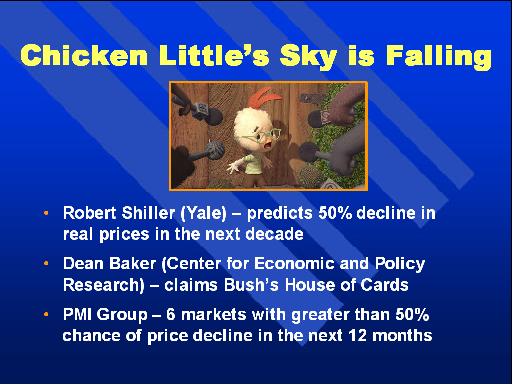
No one forced anyone to sign but only a few years ago, anyone calling a housing bubble was labeled as a Chicken Little. Take a look at this PowerPoint from a big housing presentation calling any bubble believers Chicken Little back in October 2005:

Chicken Little Slide from Presentation

Many other quotes, information, and articles can be found at the once great site, David Lereah Watch that is no longer positing since the NAR has replaced Lereah with a new housing bull, Lawrence Yun. These people are important because they are the Chief Economist to one of the, if not, most powerful housing associations in the nation. The NAR has membership of over 1.2 million folks and the majority believe the party line. They have large advertising and marketing campaigns that fund their industry. In addition, these industries are some of largest contributors to both political parties. Do you think they are looking out for you or Mr. John worrying about the risky new buyers coming into his neighborhood?


There is a great article in the Orange County Register that came out August 12 called One street’s subprime struggle. It talks about a block in Santa Ana that is the epitome of the subprime risky mortgage collapse. There is one fantastic quote from one of the older owners who is almost done paying off his mortgage:

“"I never sell. I never refinance," Zambrano said. "I don't take money out of my house to buy a car or take a vacation. I'm not stupid."

Don’t tell that to some folks in the housing syndicate. They may think you have bad money management skills and will try to get you to slap a virtual American Express to the side of your home. Maybe John has a point about being frugal and trying to manage his debt wisely. Should we try to convince Mr. Zambrano about his poor money management ability and tell him about a wonderful HELOC that’ll fund a nice trip to Europe?


Did You Enjoy The Post? Subscribe to Dr. Housing Bubble’s Blog to get updated housing commentary, analysis, and information.

July 17, 2007