
During the housing boom, agents and mortgage brokers have done extremely well. In fact, word spread so quickly that we have seen large increases in the number of people making career shifts into the housing industry. From 1989 to 2001, the membership numbers for National Association of Realtors was around 800,000. However, from 2002 to 2007 we see a dramatic and steady increase to approximately 1.4 million active members. Why the sudden increase when for over a decade, membership numbers stayed relatively stable? Welcome to the world of basic economics. The fact that money was to be made in the industry and low barriers for entry, many folks decided to roll the dice and take a chance with real estate. Simple supply and demand. In addition, with a booming market and lending standards so low that you can smell the floor, selling homes and lending money seemed to be a no brainer. Prices kept going up in double-digit sprints and many in the industry saw this as a locked in yearly wage increase. After all, if your income derives on the underlying asset price and the price keeps going up, it is by default that you will make more money since you are paid a percentage of what a home would sell for. This was all fueled by easy credit in every aspect of life. For 7 years it seemed that housing would go up ad infinitum.
The housing market is now entering the first stages of a multi-year bear market. 2007 has seen the loss of 155+ lending institutions. Over 100,000 individuals have lost their lending related jobs. Many entering neophytes are victims of poor timing. They read and listened to the housing bull books and seminars 7 years too late. Many seasoned agents and brokers realize that housing ebbs and flows. These housing veterans have sufficient contacts to weather the storm and will try to hold the fort down during these down times. From my experience in the industry and simply looking at the wage earnings for agents, it is apparent that he Pareto Principle holds true for this industry. Vilfredo Pareto, an Italian civil engineer, observed that 80 percent of the wealth in Italy was owned by 20 percent of the population. How does this apply to agents? In the case of superstar selling agents, it is the case that 80 percent of the sales happen via 20 percent of the top producing sellers. They have deep contact lists and other attributes that make them successful. When you look at the median earnings of real estate agents in the U.S., you’d be surprised by what you find. A good agent is someone that can sell a home when no one else is able to do so. See, the last few years even amateurs were able to sell homes and oversights were masked by a booming housing market. Sort of like venture capitalist throwing money at any prospective company with a dot com in its name during the raging tech boom.
Capitalism is a great thing if you let it run its course without government intervention. For example, now that the housing market is slowing down many companies are falling flat on their faces for running poor businesses. The 155+ lenders that have imploded this year are victims of inefficient business models and the market is taking care of them. After all, these companies were raking in money during the boom times. Good businesses are built with diversification to weather multiple storms. Take a look at Proctor and Gamble and General Electric. During the good times, they ventured into other businesses that allowed them to have a buffer should one industry sector falter. Many of the lenders that are now defunct saw returns too appetizing in the housing industry. Instead of going into more conservative ventures with their revenues or build war chests, they decideded to reinvest into a business model that was unsupportable.
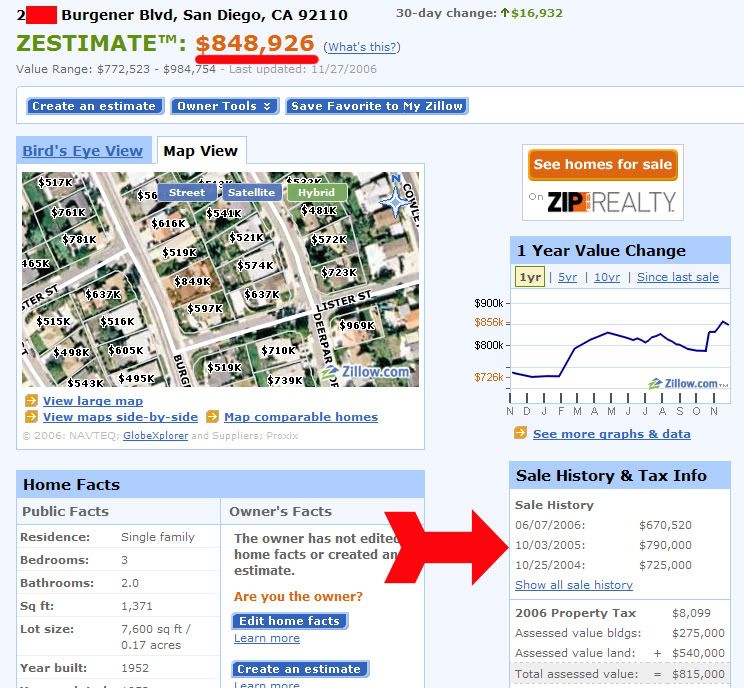
The internet is now a ubiquitous part of life in the U.S. Everyone uses Google to search for answers. If you don’t know the answer to a complex question, you can go to Google and find not only one response but probably a few thousand. Information is power. Even in the 90s, buying a home was a challenge because you didn’t have access to all the important pieces of information. If you wanted previous sales data, you would need to go to the clerks office or pay a title company to dig up the information. Most people never bothered to look at previous tax records. And finding comparable sales? The only viable source was the MLS which was under lock and key by the housing industry. Now with the advent of Zillow, ZipRealty, Redfin, HelpUSell, and other do it yourself services information on homes is no longer hard to find. The LA Times had a great article this Sunday about selling your home with different services. Do you want to know the previous sales price? This will be easy to find. What about comparable sales? Not only can you get this information but you will have it nicely displayed via a satellite hybrid image that you can sort out. And the best thing is most of these services are free or cost a small price. And in a market where 6 percent can mean the difference between you breaking even or going into a short-sale, many folks are opting to use discount services or doing it themselves.
So why will commissions drop? Here are three further reasons for the inevitable drop in commissions:
Misnomer: Only the Seller Pays the Fee
You always here this argument thrown out. Buyers shouldn’t hesitate in using an agent because it is the seller that pays the fee. The way the process is currently setup, the seller pays the typical 5 to 6 percent commission fee and should a buyer’s agent bring a worthy customer, will get a cut of the percent. This can be anywhere from 2.5 to 3 percent. So why is this a misconception? Like a stock that pays a dividend, the market already factors this into the price. You aren’t really getting the service for free because the underlying price is inflated to reflect this market standard. But as standards shift, say commissions go to a lower rate or flat fees, the price of the home will reflect the difference. We are already seeing this here in California where market pressure and multiple options are giving consumers different choices. And sellers that went 0, 3, or 5 percent down realize that 6 percent may be their entire equity, are willing to find creative ways to sell a home. Keep in mind in a hot market where the median price for Los Angeles County is $550,000, 6 percent is $33,000. As a seller, you may think twice about paying this especially in a tighter market.
This priced in model happens in many financial instruments. If you look at options that are nearing a dividend pay date, the market has already priced this into the premium. So you really aren’t getting a good deal even though this is a sort of slight of hand financial gain. And many professionals will argue that you can’t get the service that they can provide at a lower cost. This may be true depending on the person you hire. But look at the professional Hovnanian Enterprises cutting prices in their Deal of a Century campaign to unload homes. In some cases, these professionals are lowering prices by $100,000. Now that will get your attention. And these homes are new units so you don’t really need to worry about wear and tear and in many cases, these builders are now offering financing to move inventory. You can see why a downward market will put pressures on commissions.
Access to Information: MLS, Competition, Down Market
Have you used Zillow? Know about Craigslist? Ever browsed homes on ZipRealty? Then you are benefiting from the competition brought on by the industry. Many of these companies realize that you can make money from other venues such as advertising and taking a lower fee and making it up on volume. They realize that a small piece of $550,000 is enough money to invest millions of dollars into new business models. In addition, the competition is now fierce since sales are dropping and credit is tight, so now your option may be limited to a few qualified buyers that are absolutely determined to buy right now. A good agent is now earning his money trying to sell a home. No longer are multiple offers coming in like the good days. The market is now different. Many new industry folks are unable to deal with a down housing market and are going into this as a trial by fire. This is their first experience with a down market. And the last 7 years were a complete anomaly so anyone thinking we will be back to that is hoping for a deal of a century that will not come again for another century.
It is easy to find information on comparable home sales. You can easily access previous sale prices. These companies at the vanguard are finding that many buyers and sellers are willing to get their hands dirty if that means they will save $20,000 to $80,000. I always get a kick out when the rebuttal is, “well I wouldn’t expect to pilot a plane just because it is cheaper.” Flying a plane is not like selling a house. Doing heart surgery is not the same as showing an open house. There is a clear difference. Will it require work if you decide to do it? Of course. Just like owning a rental property. You will have issues come up but that is why you are rewarded financially. Otherwise, everyone would be doing it. Even savvy attorneys, title companies, and discount brokers are capitalizing on this market. If you are too lazy to review sales on Zillow or ZipRealty, drive around and see a few comparable homes, and read one of the thousands of real estate books out there then yes, maybe you should fork over your money to an expert.
Cost of Housing: People Will get Dirty for Tens of Thousands
When you are selling a $100,000 home in a slow market with few buyers, agents do earn every penny for their hard work if they bring a qualified buyer and the deal closes. Many agents across the US are not in prime areas and the percentage is not that much in nominal terms. But in the last few years, if you managed to get a listing in SoCal all you needed to do was list it in the MLS (if that) for $600,000 in a decent area and you would get multiple offers. In fact, sellers even put into their listings “sold as is” expecting buyers to put up or shut up. And guess what? Homes sold without inspections many times. Lenders couldn’t careless since banana republic mortgages were being bought by investors. So the sellers were in absolute control. It was the best sellers market in decades. It’ll be interesting to see how those in the housing industry that haven’t seen a downturn will react to this market shift (remember the jump of 600,000 NAR members since the boom?). Many of course are calling for a bailout and corporate welfare but this has little chance of making any impact in California or other high priced areas where prices are disconnected from the reality umbilical cord.
Many sellers that bought in 2004, 2005, 2006, and even 2007 that are looking to sell are quickly realizing that 6 percent is a big deal especially if they are swimming underwater. Any smart agent realizes that in slow markets quality buyers must be courted with lower prices and this may include rebates. No amount of marketing or savvy advertising will make a lender fund a buyer; you may have a willing buyer but if they don’t get financed, the deal is going nowhere. The market is changing and to be honest, those in housing will have to revert to old school ways of doing things. Adding repairs and sprucing up houses to catch a now dwindling amount of buyers. Throwing in discounts if possible. More aggressive marketing directed to bringing in qualified buyers (take note on Hovnanian advertising approach). And no, we are not even remotely close to a bottom. We had a 7 year housing bull market and only in late 2006, did we shift into a slower housing bear market. Heck, Los Angeles County returned back to its historical median record price of $550,000 last month so we haven’t seen a correction here. Expect this to last 3 to 4 years. Moreover, these new services are built to cater to price conscious buyers and sellers; in down markets with tighter credit, nothing is more precious than price.
 Did You Enjoy The Post? Subscribe to Dr. Housing Bubble’s Blog to get updated housing commentary, analysis, and information.
 Digg This!
 Add to Reddit!
 Save to del.icio.us!